

Blog
UK Business School Applications Are Falling While India’s Rise, And The Entrance Test Still Decides A Lot

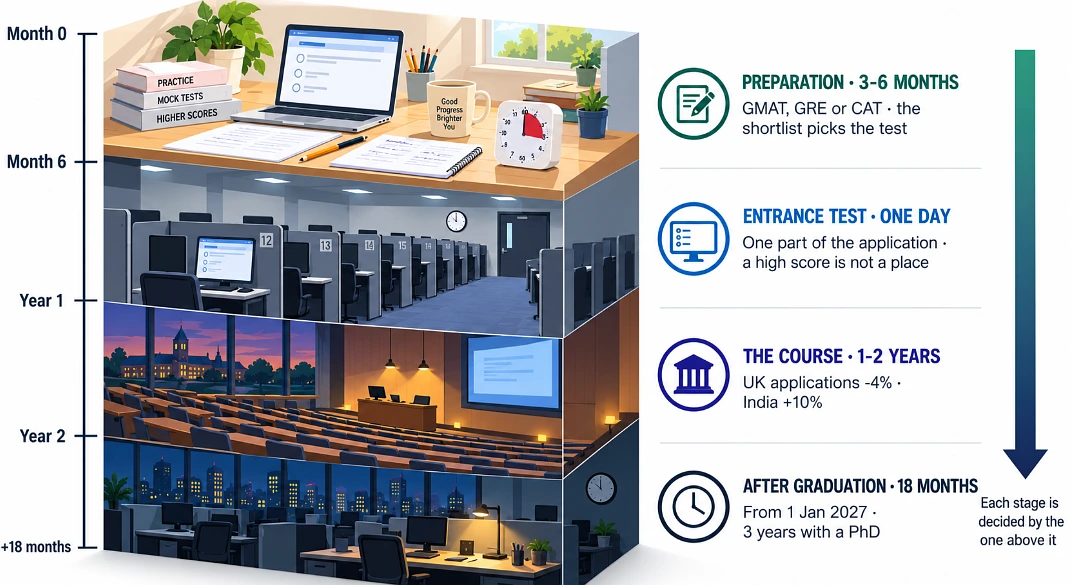
Something has been shifting in business school applications between Britain and India, and the numbers from the people who actually run the GMAT make it fairly plain. UK business schools are getting fewer applicants, schools in India are getting more, and it looks like some of the Indian candidates who might once have flown to London or Manchester could be staying at home instead, although the figures cannot prove that for certain. Whichever way someone goes, though, there is still an entrance test to get through first, and it is not always the same one.
What GMAC’s Own Numbers Show
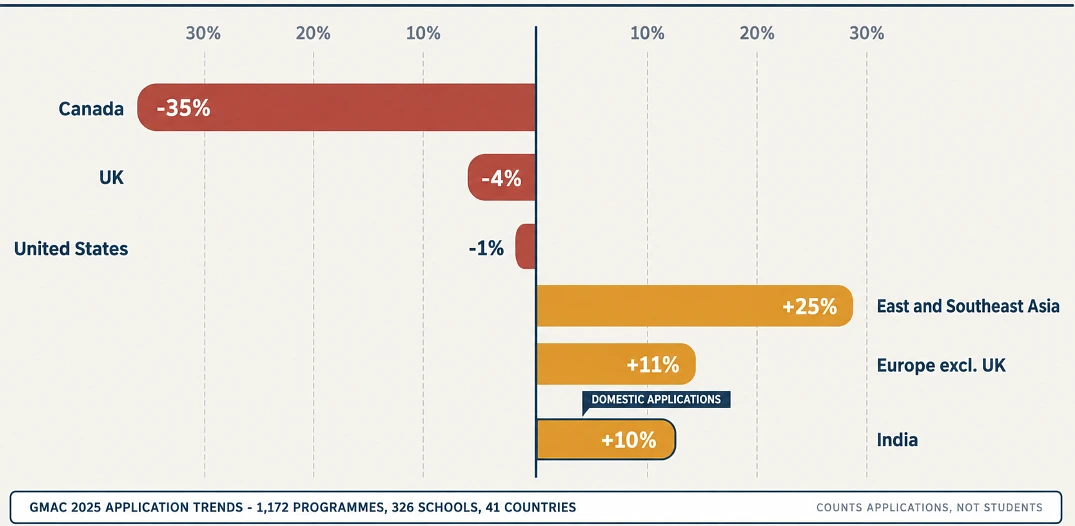
GMAC is the body that owns the GMAT, and its yearly survey of business schools is about the most reliable read anyone has on where applications are going. Its 2025 Application Trends Survey, which covered applications for the class starting in 2025 and took in 1,172 programmes at 326 schools in 41 countries, found this among the programmes that took part.
- Applications to business schools fell by 4% in the UK
- They fell by 1% in the US, and by 35% in Canada
- Applications rose by 10% in India, 11% in Europe outside the UK and 25% in East and Southeast Asia
A 35% drop in Canada is a big number, to be fair, and it makes the UK figure look mild. But the direction is the same. The traditional English speaking destinations are losing applicants, and India is one of the places picking them up.
GMAC’s own report also said that domestic applications to programmes in India grew by 10%, which is the part that matters for this story. It suggests some Indian candidates are choosing their own country rather than a different one, although the survey counts applications, not individual students, so it cannot say who would have gone abroad otherwise.
The UK Visa Numbers Are Going The Same Way
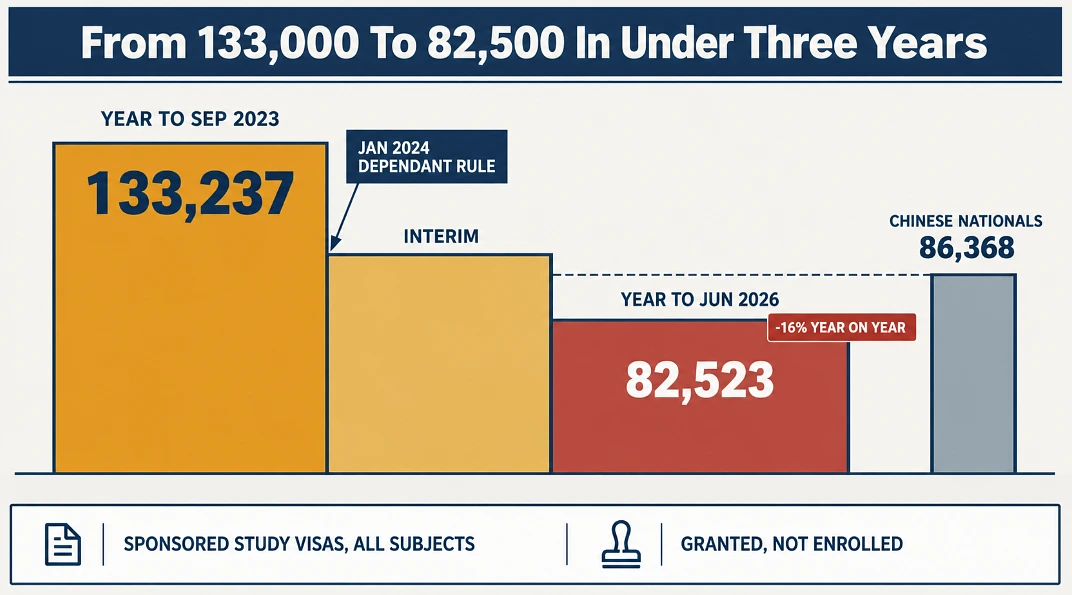
Home Office figures tell a similar story from the other end. In the year ending June 2026, Indian nationals were granted 82,523 UK sponsored study visas as main applicants, which was down 16% on the year before. Those figures cover every subject, not only business courses, and they count visas granted rather than students who actually enrolled.
That puts Indian students behind Chinese nationals, who received 86,368 student visas over the same period. Go back to the year ending September 2023 and Indian nationals were getting 133,237 sponsored study visas in a year. From around 133,000 to around 82,500 in less than 3 years is a big fall for any group of students, never mind the one that had become the largest. The Home Office itself links part of the drop in study visas to the rules brought in in January 2024, which stopped most students from bringing dependants with them.
Indians did still get the most Graduate route extensions of any nationality, at 64,495, although even that figure dropped compared with the year before. In the Home Office’s figures, an extension means further permission to stay, including switching onto a different route, rather than a renewal of the Graduate visa itself.
The Graduate Visa Gets Shorter On 1 January 2027
Another thing for future applicants to think about is the visa that lets students stay and work after their degree. Under the UK Graduate route as it stands now, anybody applying on or after 1 January 2027 will get permission to stay for 18 months instead of 2 years, unless they have finished a PhD, in which case it stays at 3 years.
For a one year master’s or MBA, that 6 months matters a lot. It is the time people use to find a job good enough to switch onto a longer term work visa, and the Graduate route itself cannot be extended. It is the date of the visa application that counts, not when the course starts or when the graduation ceremony happens, so anybody starting entrance test prep now for a UK course will almost certainly be applying after that cutoff, and under the current rules it is the 18 months they have to plan around, not the 2 years.
UK Universities Are Going To India Instead
The other half of the change is happening in India itself. Narendra Modi and Keir Starmer announced that 9 British universities are setting up campuses in India, including Southampton in Gurugram, Liverpool in Bengaluru, York, Aberdeen and Bristol in Mumbai, and Surrey in GIFT City.
Lancaster University is working on plans for a Bengaluru campus too, with its first courses expected to focus on business, management and computing. So a student in India who wants a UK university name on a business degree does not necessarily have to leave the country for it any more.
These campuses are mostly aimed at undergraduate and taught postgraduate courses rather than MBAs, so they will not replace a top UK business school for everybody. A UK degree studied entirely in India does not lead to the UK Graduate visa either, because that route needs the study to have been done in the UK. But they are part of the same picture, which is UK education going to Indian students instead of waiting for them to come over.
What Does Not Change, Whichever Way An Applicant Goes
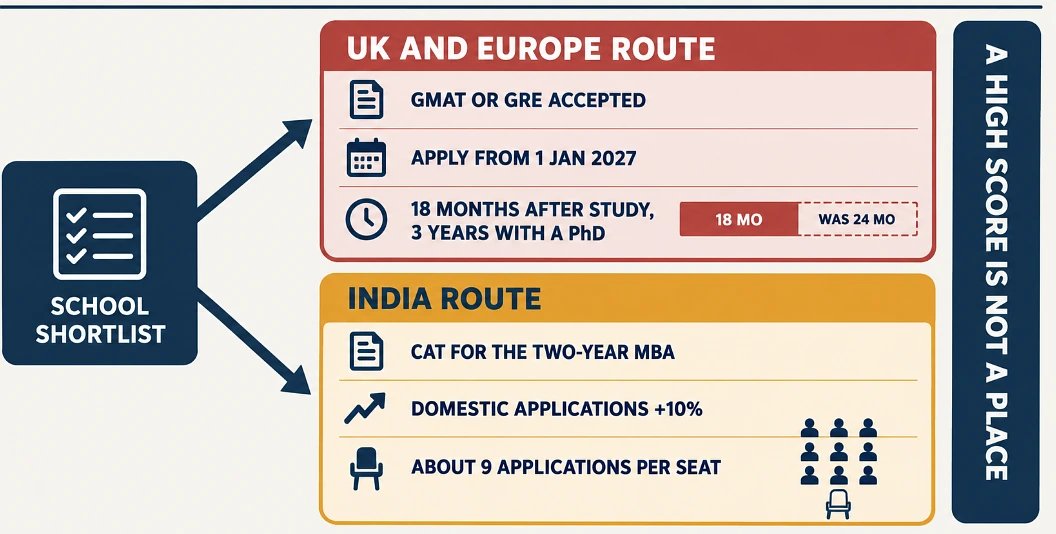
One thing holds steady through all of it. Whether somebody is applying to an Indian business school, a UK one, or somewhere in Europe, there is nearly always an entrance test, but which test depends on the school and the route. London Business School’s MBA takes either the GMAT or the GRE and says it has no preference between them, while IIM Ahmedabad’s standard two year MBA route for Indian applicants uses the CAT. The score is also only ever one part of the application, and London Business School says plainly that a high score does not guarantee a place.
With UK schools seeing fewer applicants and Indian schools seeing more, the competition may be moving rather than disappearing. More applications could mean tougher odds at some Indian programmes, but that depends on how many places there are and who is applying, and GMAC’s own India figures put the median at about 9 applications per seat in both 2024 and 2025.
The preparation matters as much as it ever did, then. It is just aimed at a different set of schools, and sometimes at a different test.
Why More Practice Material Does Not Always Fix A Score
There is no shortage of GMAT material about. Practice questions, guides, full mock tests, most of it free or cheap. The problem for most people is not finding things to study, it is knowing what to study first, and what to do after getting something wrong.
Getting 5 questions wrong in a practice set does not say much on its own. Was the concept unclear, was the question misread, did one problem eat 4 minutes, or did the last few get rushed? Those are 4 different problems with 4 different fixes, and doing another practice set does not tell you which one it was.
That is honestly where structured help earns its money, if it earns it anywhere. A teacher who looks at the pattern across 3 or 4 mock tests can often spot whether the issue is maths, reading, or timing much faster than somebody working alone.
Where Coaching Helps, And Where It Does Not
A good coaching institute for GMAT gives a study plan in a sensible order, so the hard topics are not left until the last fortnight, and it reviews mocks properly instead of just reporting the score.
The mock review is the bit people skip when they study alone. A proper review looks at the wrong answers, but also the right ones that took too long or were guessed, because those are the ones that go wrong on the day when the pressure is on.
None of that means coaching is needed by everybody, to be fair. Plenty of people get the score they want on their own. It tends to help most for people who have already plateaued, or who keep making the same kind of mistake without being able to see why.
Online Prep, If The Structure Is There
A lot of GMAT candidates are already working, which makes fixed class times hard. GMAT online prep can fit round that, studying in the evening or at the weekend without travelling anywhere.
Convenience on its own does not make an online course any good, though. The things worth checking before paying for one are fairly simple.
- Is there an actual practice plan between the lessons, or just recorded videos?
- Can doubts be taken to an instructor, and how quickly do they answer?
- Are full mock tests included, with a proper review of them?
- Is there some way of tracking progress from one week to the next?
If the answer to most of those is no, it is a video library, not a course.
Before Signing Up For Anything
Anybody aiming at a UK business school for 2027 or 2028 is planning around an 18 month Graduate visa under the current rules, not 2 years, and anyone aiming at an Indian school is applying at a time when applications there are growing. Either way, the first thing to check is which test the schools on the shortlist actually accept.
Once that is clear, take one full mock of that test before paying for any course, and write down which questions went wrong and why. That one sheet of paper will tell you more about what kind of help you need than any brochure will.