

Blog
UK Businesses Are Losing £416 Million a Year on Staff Training That Doesn’t Actually Work
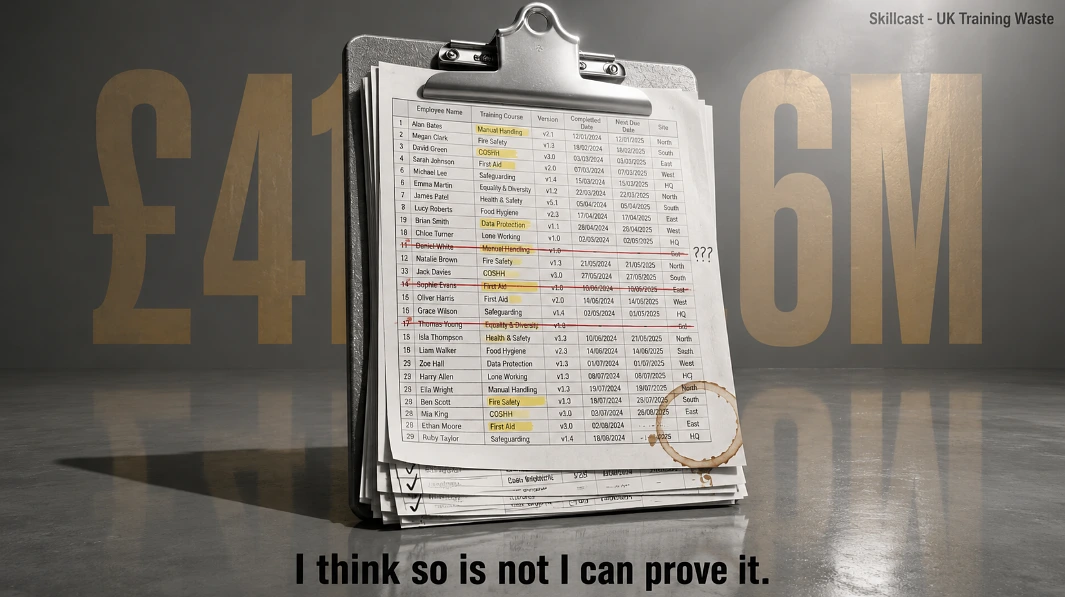
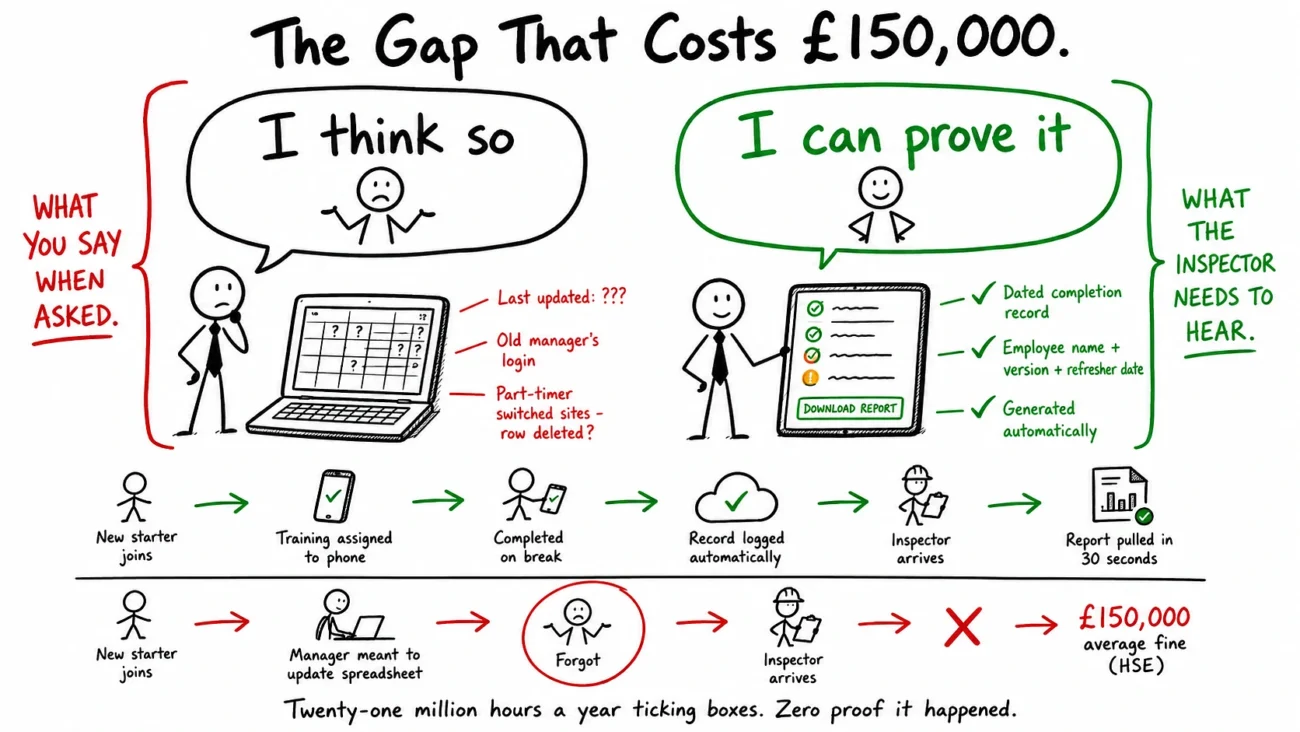
Look, if you run a care home or a restaurant or a cleaning company, you already know your training records are a mess. You just haven’t had time to fix it because the actual work keeps getting in the way. There’s a spreadsheet somewhere, probably on the old manager’s desktop login, and it might be current or it might not, and the honest answer when someone asks “has everyone done their fire safety refresher?” is usually “I think so.”
That gap between “I think so” and “I can prove it” is what Skillcast put a number on earlier this year when they found UK businesses are losing roughly £416 million annually to training that ticks boxes without actually developing anyone. Twenty-one million working hours a year going into programmes that exist purely to say they happened. Meanwhile the HSE’s average fine for a health and safety breach sits at £150,000 and they’re not interested in whether you meant to do the training, they want the dated completion record with the employee’s name on it.
The legal bit, because this is where the fines come from
Nobody starts a small business thinking about COSHH training schedules. But the law doesn’t care what you were thinking about when you started, and the list of what you’re actually supposed to deliver, document, and refresh on a cycle is longer than most owners realise until an inspector asks for it:
- Health and safety induction for every single new starter, no exceptions
- Fire safety and it needs to be refreshed every year, not just once at onboarding
- Manual handling if anyone in the role is lifting, carrying, pushing or pulling anything
- COSHH wherever cleaning chemicals, clinical waste, or hazardous substances show up
- GDPR because yes, even a fifteen-person care home handles personal data
- First aid with at least one certified first aider physically on site
- Food hygiene for anyone touching food, which covers care homes as well as restaurants
- Safeguarding across care, education, and anything involving children or vulnerable adults
The thing about this list is that every item on it needs a paper trail. Not “we told them about it in the first week” but a record showing they completed it, when, which version, and when the refresher is due. That’s what CQC inspectors look for in care homes. That’s what environmental health officers look for in restaurants. And the document they want to see is never the WhatsApp message with three thumbs-up reactions.
Spreadsheets stop working the month someone leaves
You know exactly how this plays out because you’ve lived it. The spreadsheet is fine when there are eight people and nobody’s going anywhere. Then someone leaves, someone joins, the part-timer switches to a different site, and suddenly nobody’s sure whether the new person did their manual handling or just watched someone else do it. The colour coding made sense to whoever set it up. It doesn’t make sense to the person who inherited it.
There are about 170,000 hospitality businesses in the UK right now and 97.7% of them are small. Turnover in hospitality runs higher than almost any other sector, which means constant onboarding, constant training cycles, constant record keeping that needs updating every time someone walks in or out the door. Care homes have the same churn problem plus a regulator who visits. Miss a safeguarding refresher and it shows up in the CQC report. Miss several and your rating drops. Your staff are on their feet twelve hours a day dealing with people who actually need them, and the idea that they’re going to sit down at a computer and log into a training portal between medication rounds is fantasy.
Teachable and Kajabi keep showing up in searches and they’re the wrong answer
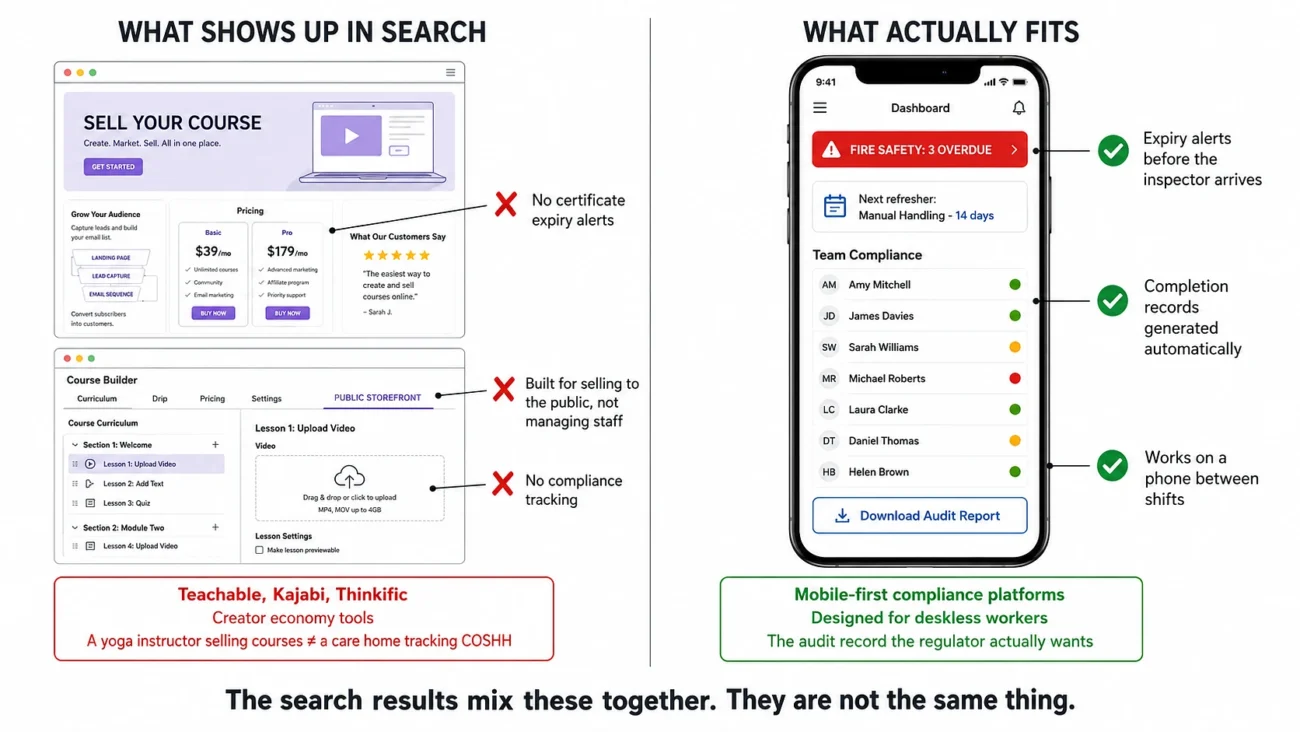
This is the bit that wastes people’s time and I’ve seen it happen more than once. You search for “staff training platform” and the results mix together tools that have absolutely nothing to do with each other. Teachable starts at $39 a month and Kajabi starts at $179 a month and they both look professional and they both mention “training” and “courses” and neither one is designed for what you actually need.
Teachable is for a yoga instructor selling an online course to paying customers on the internet. Kajabi is for a business coach building a membership site with email marketing funnels. Both are fine at what they do. Neither tracks compliance certifications, handles shift-based communication, delivers training to someone’s phone at 6am before a care shift starts, or produces the kind of documented completion record that satisfies a regulator. You could spend a month setting up Teachable for your care home and end up with something that looks like an online school for the public rather than a compliance system for your staff.
What actually fits this problem is the category of platform built specifically for teams that don’t sit at desks. iTacit is one of them. Mobile-first, designed around the assumption that your employee doesn’t have a company email, doesn’t use a laptop during the working day, and needs to complete training and receive updates from their phone between shifts or on a break. The manager’s dashboard shows completions, expiring certificates, and gaps across the team without anyone having to manually update a spreadsheet. That’s the audit-ready record, generated automatically. Care homes, restaurants, cleaning companies, logistics firms and the like are the bread and butter use case because those are the industries where the staff physically can’t sit at a computer and the regulator physically will show up.
Enterprise platforms exist but they’re solving a bigger problem than yours
If you employ five hundred people across multiple offices and you have an HR department with a dedicated learning and development team, there are platforms built for that scale. Learn Amp ties training into employee development and performance reviews. Valamis does enterprise learning with integrations into SAP and Microsoft 365. eFront lets you host the whole system on your own servers if your industry requires it.
They’re all capable. They all assume you have an IT team to set them up and a budget that runs into tens of thousands. For a thirty-person care home or a restaurant group with four sites, that’s not what you need. You need something that works on a phone, tracks the compliance stuff automatically, and doesn’t require a six-week implementation project before anyone can log in.
The one question worth asking before you spend anything
Can you pull up a record right now, today, showing every member of your team, what they’ve completed, when they completed it, and when their next refresher is due?
If yes, genuinely yes, leave it alone.
If the honest answer involves opening a spreadsheet, squinting at it, and saying “probably” then you already know the system isn’t working. The question is whether you fix it before the inspector asks or after.