

Blog
What Is Layered Lighting and How Do You Use It in Every Room
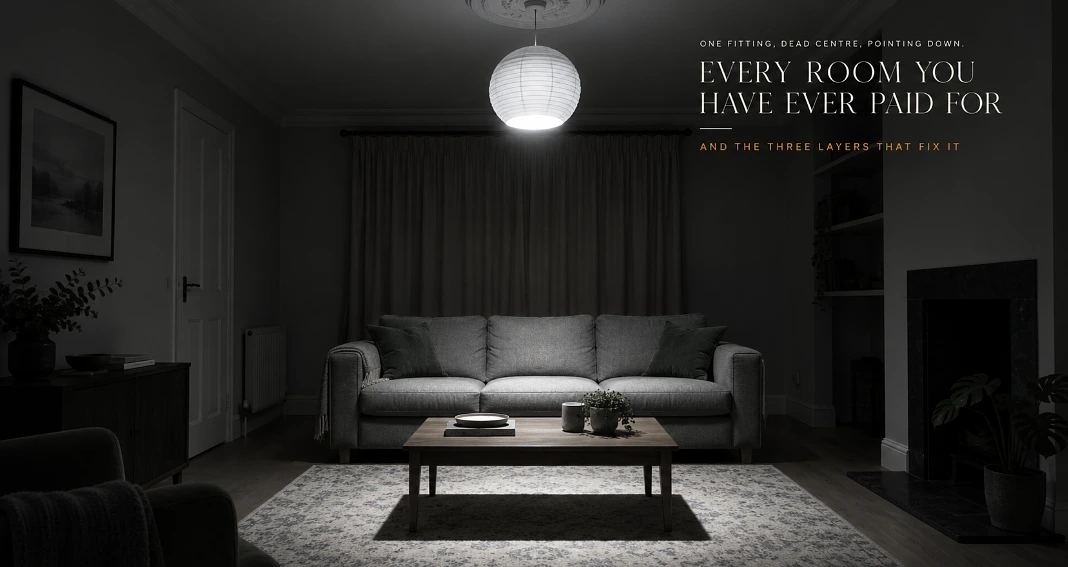
Sit in a British living room at nine at night and count the light sources. For most of us the answer is one, screwed into a rose in the middle of the ceiling, exactly where the builder put it.
That single fitting is why a room you have spent real money on still feels like a doctor’s waiting room after dark. Paint, flooring, a sofa that took three weeks to arrive, all of it flattened by one bulb firing straight down.
Layered lighting is the answer, and it sounds far more technical than it is. Most of it needs no electrician, no chasing walls, no permission from anybody.
What Layered Lighting Actually Means
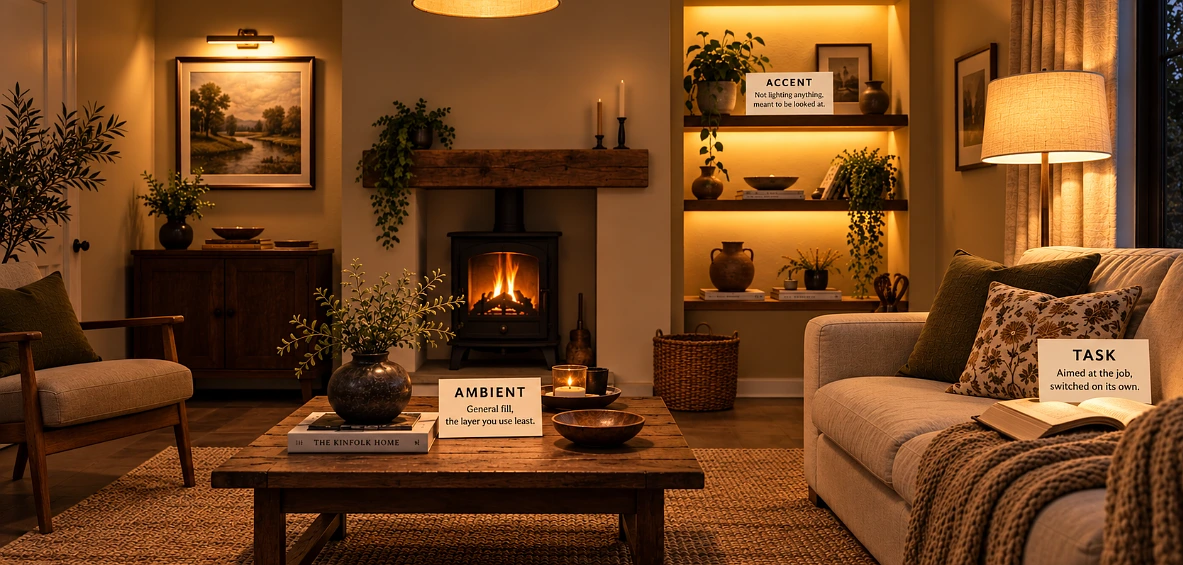
Three types of light in the same room, each doing a different job, on separate switches or plugs so they work independently.
That last bit is where it usually falls apart. A ceiling light, a floor lamp and a table lamp all switched on at six and left burning until bed is not layering. It is just more light.
Layering means dropping a room from bright and practical to low and warm without touching a bulb.
No gallery lights a room from one point overhead. Hard to see why a living room should.
The Three Layers and What Each One Does
Ambient is the general fill, the light that lets you cross the room without treading on the cat. Usually the ceiling fitting. It should be the layer you use least in the evening, not most.
- Task is aimed at a job. Reading, chopping, working, putting on make-up. Brighter, positioned so your own body is not casting a shadow across the work, and switched separately from everything else.
- Accent is not there to light anything. It exists to be looked at. A wall, an alcove, a picture, a texture. This is the layer that makes a room feel considered rather than just lit.
Nearly every home has the first, because it came with the house. Plenty have something like the second. The third is where the gap sits, and it is the cheapest of the three to add.
Why the Accent Layer Gets Skipped
Because it looks like a luxury. no one ever ruined a dinner because the alcove was dark.
What you get back is depth. A flat ceiling wash puts everything at the same brightness, and a room lit that way looks like a face shot with a phone flash. Light one vertical surface and the eye finally has somewhere to sit.
Start here for a practical reason as well. Most of this layer never touches your wiring. Picture lights, plug-in wall fittings, an uplighter shoved behind a plant, illuminated wall pieces, all of it runs off a normal socket, which keeps the lot outside Part P in England and Wales, since that covers fixed installation and not things you plug in.
Which is roughly how custom neon signs ended up out of bars and studios and into hallways and living rooms. They sit flat against the wall, eat no floor space, and throw a low warm glow while being the thing you look at.
Two limits, so no one is disappointed. Accent light will not rescue a badly proportioned room, and it cannot do much against a ceiling fitting that is too bright and will not dim. That is why it comes last.
Getting Colour Temperature Right
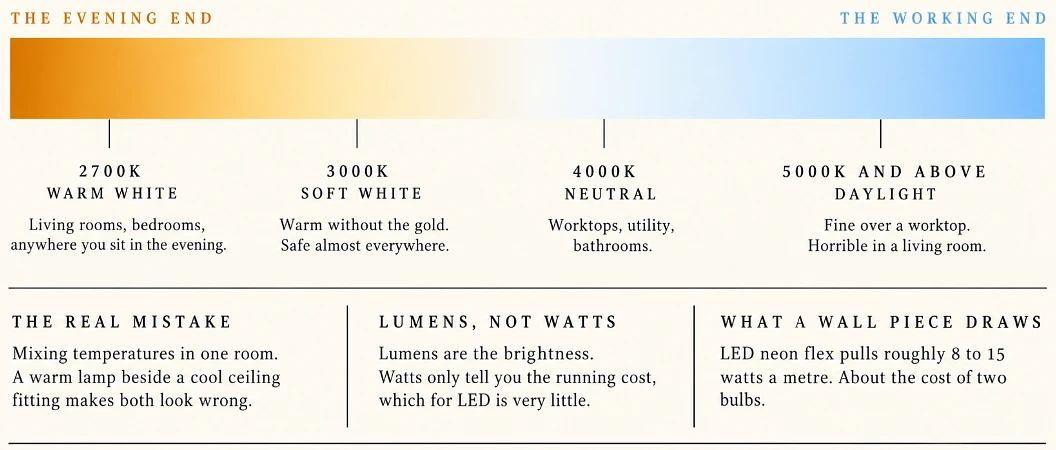
Kelvin. It is printed on the box and almost no one reads it.
2700K is warm white, a bit golden, close to the old incandescent bulbs. 4000K is neutral. From 5000K up you are into daylight, which is fine over a worktop and horrible in a living room.
Mixing them in one room is the real error. A warm lamp sat next to a cool ceiling fitting makes both look wrong, and neither looks like a decision.
Two more numbers. Brightness comes in lumens now rather than watts, because LEDs killed the old relationship between power drawn and light produced. Watts only tell you what it costs to run, which for decorative LEDs is very little. LED neon flex pulls roughly 8 to 15 watts a metre depending on the colour and how densely the LEDs sit, so a wall piece runs at about the cost of two bulbs.
How to Layer a Living Room Without New Wiring
Dimmer on the ceiling light first. One change, and an on-or-off layer becomes something you can actually use.
If the bulbs are LED, get a trailing-edge dimmer. The older leading-edge type was made for incandescent loads and wants a minimum wattage that efficient LEDs never hit, and that mismatch is behind most of the buzzing and flickering people blame on dimmers.
Then the other two layers, both from sockets:
- A floor lamp next to whichever chair people actually read in, set slightly behind the shoulder.
- One accent source on a wall, at seated eye level rather than standing height.
Three switches, three moods, no one drilling into your plaster.
Socket position is the thing that will stop you. Look at where your plugs already are before you settle on a corner that has none.
Kitchens and Bedrooms Want Opposite Things
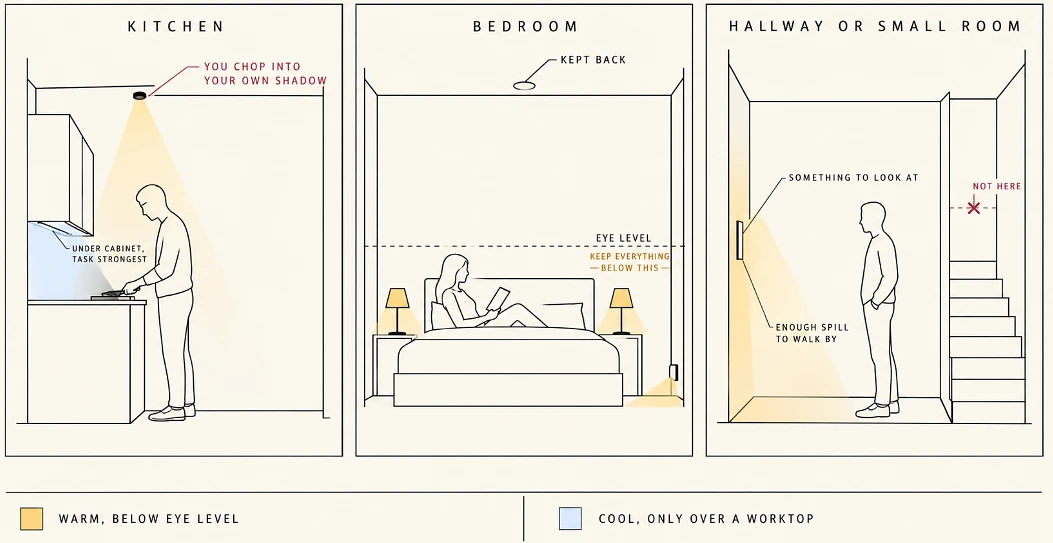
Kitchens need task light to be the strongest layer. Under-cabinet strips beat any ceiling fitting, because a downlight behind you means you are chopping into your own shadow. A worktop is one of the few places in a house where cooler light earns its place.
Bedrooms go the other way. Keep nearly everything below eye level and warm, so the last switch you hit at night is not an overhead pointed at the bed. Bedside lamps on dimmers, a low wall piece, and the ceiling light kept back for the ten minutes a week you are rummaging in a drawer.
Hallways and Small Rooms Have Only Wall Space
Narrow rooms are the awkward ones. No floor for a lamp, no surface for a table light, quite often no window either.
The wall is all you have got, so the accent layer ends up doing two jobs at once. A lit wall piece at mid height gives you something to look at and enough spill to walk by, and there are not many free wins like that in home lighting.
Keep it off the staircase wall at eye level though. Anything bright in your eyeline on the way down a flight of stairs stops being decorative in a hurry.