

Blog
Why So Many British Professionals Still Pick American Business Schools

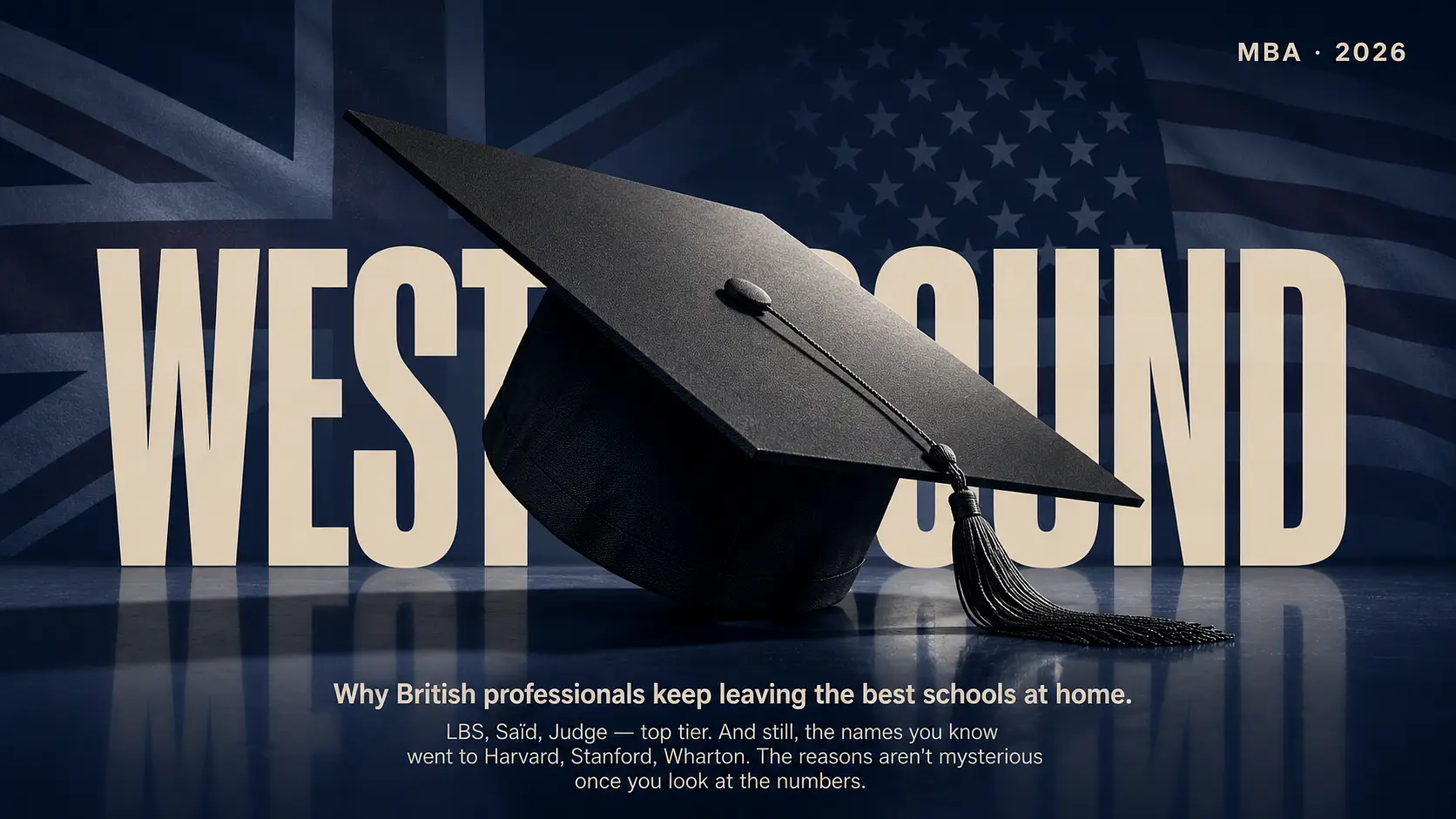
So you’re sitting there looking at LBS, Saïd, Judge, maybe Cranfield or Warwick, and wondering whether it actually makes sense to apply to Harvard or Stanford or Wharton instead. These are some of the best schools on the planet right here in Britain. Why would anyone with access to them go through the whole circus of GMAT prep and US essays and visa paperwork to study somewhere else?
Britain has some of the best business schools in the world. London Business School, Saïd at Oxford, Judge at Cambridge, Warwick, Cranfield — these aren’t fallback options. They sit comfortably in any global top twenty. So it’s a fair question why thousands of British professionals each year still apply to Harvard, Stanford, Wharton, Booth, Kellogg, MIT Sloan and Columbia instead.
Three reasons keep showing up when you look at the people who actually did it. Salary is the first one and it’s bigger than people think. The second is that a US two-year MBA is structurally built for switching careers in a way British one-year programmes just aren’t.
The third is the network, particularly if you want to build something around US capital. Rishi Sunak went from Oxford to Stanford. George Weston, who runs Associated British Foods, went from Oxford to Harvard. Philip Johnston, born in Guildford, did a Wharton MBA and then his company Starcloud became the fastest unicorn in Y Combinator history a couple of months back. None of these people lacked options at home. They all picked America anyway, and once you look at the numbers it stops being mysterious.
1. American MBA salaries are much higher than British ones
Honestly, this is the bit that most people quietly admit is the real reason, even when they cite networks or prestige in public.
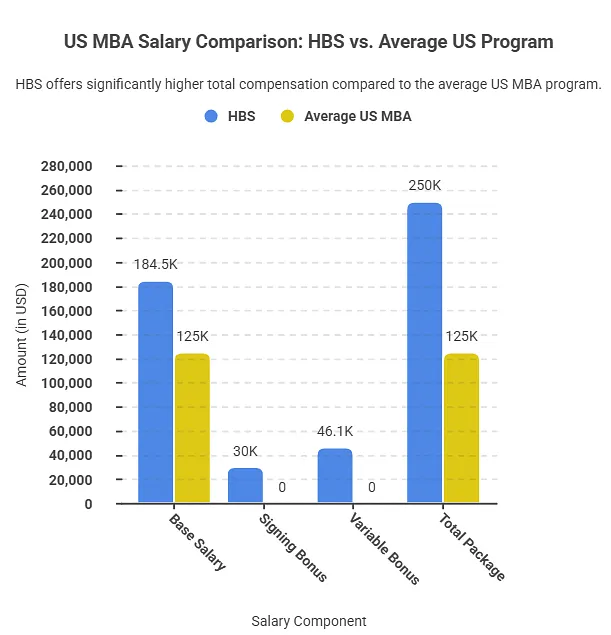
Harvard Business School’s most recent employment report, the one for the Class of 2025, puts the median base salary at $184,500. On top of that the median signing bonus is $30,000 and the median variable bonus is $46,125. Add it up and the typical Harvard MBA is walking into a package north of $250,000 in their first year. For graduates going into consulting it’s $190,000 base. Private equity, $188,000. Tech, $178,000. The average across all US MBA programmes, not just the elite handful, sits closer to $125,000 according to the Graduate Management Admission Council’s most recent recruiters survey.
UK numbers don’t get there. Even at LBS, which is genuinely a top global school, the salary outcomes sit lower in pure pound terms, and that’s not a comment on programme quality. It’s the labour market. A McKinsey associate in London earns less than a McKinsey associate in New York for the same work. A Goldman analyst in the City earns less than one in Manhattan. Bonuses are smaller, equity components are usually thinner or absent, and the differential persists at every level afterwards.
Here’s the bit that doesn’t get talked about enough though. Eighty-eight percent of HBS Class of 2024 graduates stayed in the United States to work. Only five percent went to Europe. The salary maths only really pays off if you’re willing to base yourself in America for the meaningful part of your post-MBA career, because that’s where those numbers actually exist. If you’re set on coming straight back to London after graduating, you’re paying the US premium without collecting most of the benefit. Worth being honest with yourself about that before you start the application.
2. The two-year US format is built for switching careers
If you’re already in finance and want to stay in finance, why on earth would you spend two years and a quarter of a million dollars on an MBA when you could do it in one year at LBS?
You probably wouldn’t. And that’s the point. The US two-year format isn’t designed for people sharpening skills in a field they already know. It’s designed for people changing direction.
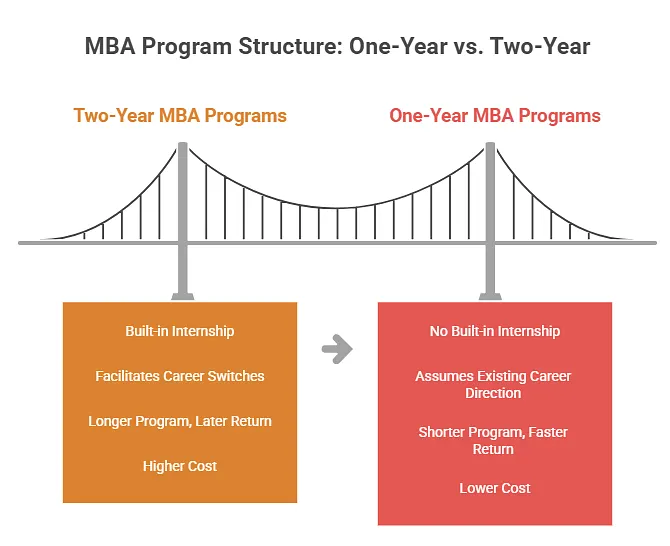
Harvard, Stanford, Wharton, Booth, Kellogg, MIT Sloan, Columbia — all two years. Saïd, Judge, INSEAD (which is technically ten months) — all one year. LBS sits between them with a flexible 15 to 21 month structure. The reason the two-year format exists is the summer between year one and year two. That’s the internship summer, and it’s where the actual career switch happens. Engineer wants to move into finance, takes a banking internship in the summer, converts it into a full time offer. Lawyer wants to move into tech product management, takes a PM internship, converts it. The internship is the pivot. One year programmes don’t have it built in.
Take Rishi Sunak’s path. PPE at Oxford, then Goldman Sachs as an analyst from 2001 to 2004. He could have stayed in banking. Plenty of his Oxford classmates did. Instead, he went to Stanford on a Fulbright in 2004, did the MBA, came back to the UK in 2006 and joined The Children’s Investment Fund Management as part of Sir Chris Hohn’s team. Two years later they made him partner. The Stanford MBA is what got him from analyst-track investment banking into hedge fund partnership, which is a jump that’s genuinely hard to make without something like that on your CV. The MBA wasn’t a status badge. It was the structural mechanism that made the switch possible.
You see the same pattern with people moving from engineering into product management, from medicine into healthcare investing, from the military into consulting, from law into venture. Two years gives you the time to actually retool. One year gets you back to work faster but assumes you mostly know where you’re going.
3. The network sits where the capital sits
Here’s something that surprised me when I started looking into it properly. The salary thing matters but only for so long. The network thing matters for the next thirty years.
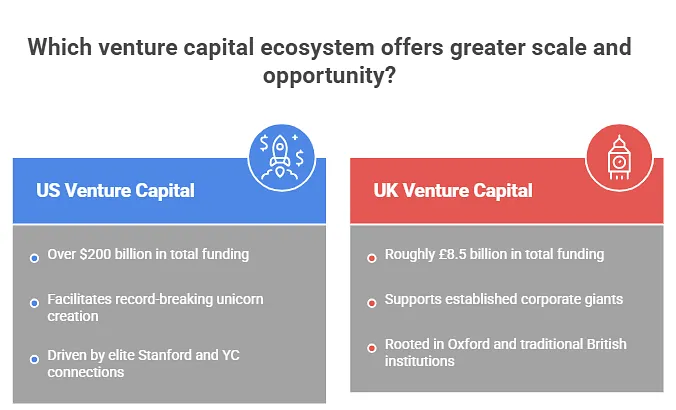
The US venture capital industry deployed over $200 billion in 2024. UK venture capital across the same year sat at roughly £8.5 billion according to the BVCA. Both are healthy. They are not remotely the same size. If you want to start a company that needs to raise serious money, or join one that’s already doing it, being inside the US network during your formation years matters in a way that statistics don’t quite capture.
Look at what Philip Johnston did. Born in Guildford in 1986, undergrad at Nottingham, master’s at Columbia, then a Wharton MBA. After Wharton he started Starcloud, which builds orbital data centres. He went through Y Combinator. In March 2026 the company hit a $1.1 billion valuation, less th
an eighteen months out of the programme. Fastest unicorn in YC’s history. The Wharton credential, the YC network, the Sand Hill Road investor relationships, his own classmates from Wharton — none of those are separate things. They’re the same thing, working together, and they’re concentrated in a country that isn’t Britain.
The Sunday Times Rich List had Sunak and his wife Akshata Murty, who he met at Stanford, sitting on a combined fortune estimated at around £730 million in 2022. She’s the daughter of the Infosys founder. They met because he was at Stanford and so was she. Networks compound, and they compound in particular places.
4. There are real reasons to pick a British school instead
Now look, none of this means a US MBA is automatically the right call.
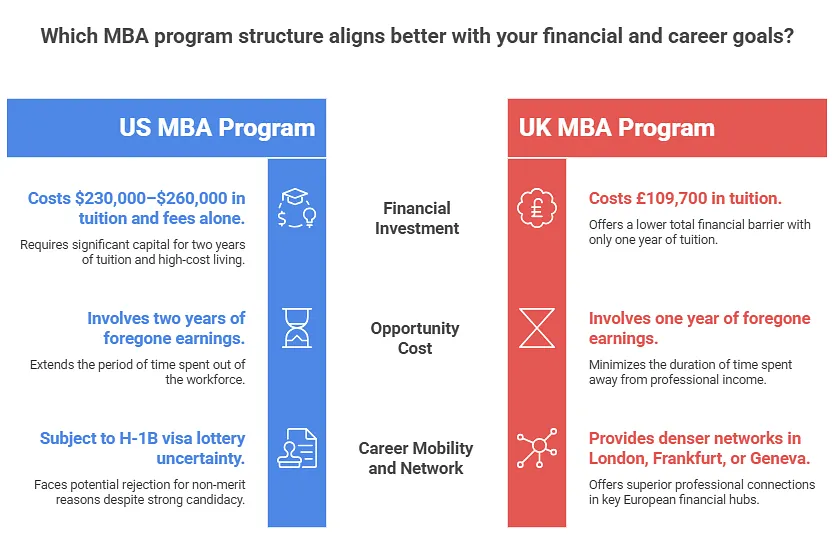
The cost gap is brutal. A two-year programme at HBS, Stanford or Wharton runs you $230,000 to $260,000 in tuition and fees alone, and that’s before you’ve thought about Boston or Bay Area rent for two years. LBS’s fees for 2025 entry sit around £109,700. INSEAD is a bit higher in euro terms but still comfortably below American levels. Once you factor in two years of foregone earnings instead of one, the all-in cost of a US programme over a UK one can comfortably exceed £150,000.
The visa picture has also got harder. The H-1B lottery means even strong candidates can be turned down for reasons that have nothing to do with merit, and US immigration policy direction over the past year has been tightening in places. Assuming you’ll graduate from Harvard and walk straight into a US job is not as safe an assumption as it was a decade ago.
And if your career is going to play out in London, Frankfurt, Paris, Amsterdam or Geneva, an LBS or INSEAD network is genuinely better for that. It’s denser where you’ll actually be working, the format is faster, and for industries where Britain plays at global scale — fund management, professional services, life sciences, fintech — a Saïd or LBS credential is taken as seriously as anything from across the Atlantic.
The honest answer to “should I do a US MBA” is “depends what you’re trying to do with it.” Same as most big decisions. The mistake is assuming the question has one answer.
5. The US application process is harder than people expect
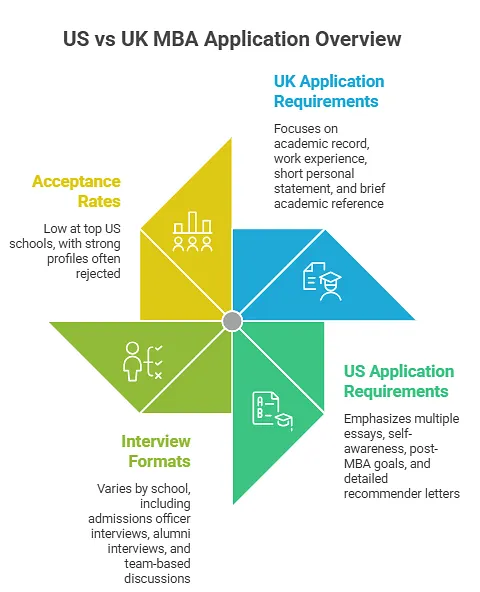
You’ll have heard that acceptance rates at top US schools sit around seven to twelve percent. That’s the public number and it’s correct as far as it goes. What it doesn’t capture is that the application itself is structurally a different beast from a UK or European one. Different essays, different recommender system, different things admissions committees actually weigh.
UK applications tend to focus on academic record, work experience, and a relatively short personal statement. US applications expect you to write essays that demonstrate self-awareness, post-MBA goals that are specific without being rigid, leadership stories with concrete impact, and a coherent reason why this school in particular. They expect your recommenders to write 600-word letters with examples and ratings, not the two-paragraph reference a UK academic might dash off. The interview formats differ too. HBS does a 30-minute interview where the admissions officer has read everything you’ve submitted in detail and will ask you to defend specific claims. Stanford does it through alumni who have their own framework. Wharton runs a team-based discussion where they’re watching how you behave in a group as much as what you say.
British applicants who treat the US application like a UK one with a different postcode tend to get rejected, even when they have strong profiles. Strong profiles get rejected from Harvard all the time. The application is the part where preparation actually pays back its cost several times over, and for serious candidates working with mba admissions consulting that genuinely understands the American system rather than the British one is one of the more sensible early investments to make. Not because you can’t write your own essays. Because you don’t always know what you’re being assessed on, and someone who has read thousands of these does.
The MBA decision isn’t really about prestige or rankings. It’s about matching the programme to the career you actually want, in the country you actually want to live in, at a cost you’re actually able to bear. For some British professionals that points clearly at America. For others it points just as clearly at staying home. The honest answer is the boring one nobody wants to give: it depends, and it depends on facts about you that no league table is ever going to capture.