

Blog
Why Your Black Friday Cart Meets the Minimum Spend but Still Gets No Discount


Black Friday promotions often look straightforward: spend a certain amount, enter a promotional code, and receive a discount. Yet a shopper can reach the advertised minimum spend and still find that the discount does not appear at checkout.
This situation does not necessarily mean the coupon is invalid. The problem may involve how the retailer calculates eligible spending, which products qualify, or whether the promotion can be combined with other offers.
Understanding these conditions can help shoppers identify the actual issue before removing products, increasing their order value, or abandoning a purchase.
Why Meeting the Minimum Spend May Not Be Enough
A promotion advertised as “$20 off orders of $100 or more” may appear to have one simple requirement. In practice, retailers can apply additional conditions that affect eligibility.
For example, a cart might contain $110 worth of merchandise, but only $85 may count toward the promotion if certain products are excluded.
The important distinction is between the total cart value and the eligible merchandise subtotal.
Retailers may calculate promotional thresholds before taxes and shipping fees. They may also exclude gift cards, clearance products, selected brands, or items already receiving another discount.
These restrictions vary by retailer and promotion. Shoppers should not assume that every amount displayed in the cart contributes toward the advertised minimum.
Four Conditions Worth Checking Before Trying Another Code

1. Eligible merchandise versus total cart value
The first step is to determine which products count toward the minimum spending requirement.
A hypothetical $120 cart could include $30 in excluded merchandise. If the retailer requires $100 in eligible purchases, the remaining $90 would not qualify.
Rather than adding another item immediately, shoppers should review the promotion’s eligibility language.
2. Product and category exclusions
Black Friday offers sometimes apply only to selected categories, collections, or participating brands.
A general-looking promotional banner may lead to terms that exclude electronics, premium products, newly released merchandise, or third-party marketplace listings.
The restriction may be located in the offer details rather than the headline.
3. Coupon stacking restrictions
Another common issue involves combining promotions.
Some retailers allow promotional codes alongside automatically applied Black Friday prices. Others prohibit stacking or accept only one discount code per order.
If a checkout page already includes an automatic promotion, an additional code may be rejected even when the cart otherwise meets its minimum spend.
The appropriate response is to compare the available offers rather than assume that combining them will produce the largest discount.
4. Account, timing, and regional conditions
Some offers are restricted to new customers, loyalty members, selected locations, or particular payment methods.
Expiration times may also depend on the retailer’s specified time zone.
A code can therefore remain visible online while no longer being eligible for a particular account or order.
A Practical Way to Diagnose a Missing Black Friday Discount
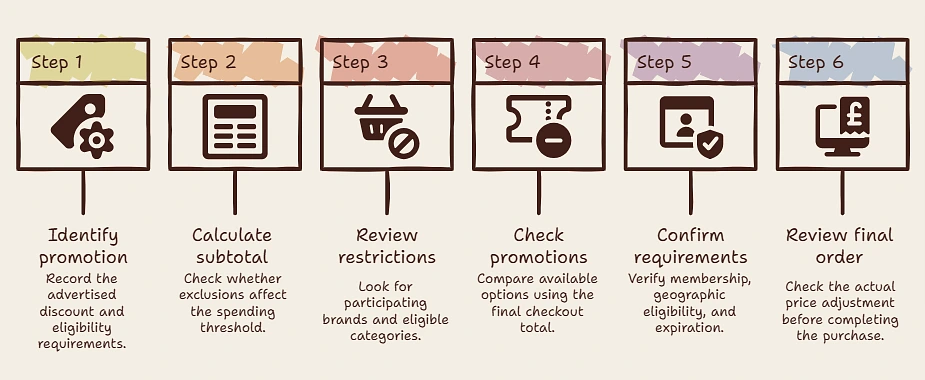
A structured review can reduce unnecessary coupon attempts.
Step 1: Identify the exact promotion.
Record the advertised discount, minimum spend, and any visible eligibility requirements. Distinguish between a coupon code and an automatically applied checkout promotion.
Step 2: Calculate the eligible subtotal.
Check whether excluded products, delivery charges, taxes, or existing discounts affect the spending threshold.
Step 3: Review product-level restrictions.
Look for participating brands, eligible categories, clearance exclusions, and marketplace seller limitations.
Step 4: Check whether another promotion is active.
If the retailer permits only one offer, compare the available options using the final checkout total.
Step 5: Confirm account and expiration requirements.
Verify membership status, geographic eligibility, new-customer restrictions, and the offer’s stated expiration.
Step 6: Review the final order before payment.
A code being accepted does not always mean that the expected discount has been applied to every item. Check the actual price adjustment before completing the purchase.
Where HotDeals Fits Into the Checking Process
When promotional conditions are scattered across multiple pages, coupon platforms can provide another place to review available offers.
HotDeals is a verified coupon platform where real users test promo codes so shoppers don’t have to.
A shopper can search for a retailer on HotDeals, examine listed offers, and review available conditions before returning to the retailer’s checkout.
The practical value is not simply finding another code. It is identifying which offer may be relevant to the purchase and which restrictions require additional attention.
For example, if a listed promotion indicates a minimum order requirement or selected-product limitation, that information can help the shopper decide what to check on the retailer’s website.
However, the retailer’s official terms and checkout calculation remain authoritative. Coupon listings may not capture every account-specific or rapidly changing Black Friday restriction.
When the Best Decision Is Not to Use the Coupon
A failed discount can tempt shoppers to add products just to reach a promotional threshold.
That decision may increase spending rather than create meaningful savings.
If a shopper needs an additional $25 of merchandise to qualify for a $10 discount, the promotion may not be financially useful unless those additional items were already needed.
The same principle applies when switching products solely to satisfy category restrictions or signing up for a paid membership to access a limited offer.
A promotion should support an intended purchase, not determine whether the purchase is necessary.
Final Takeaway
When a Black Friday cart reaches the advertised minimum but receives no discount, the cause may be more complicated than an invalid coupon.
Eligible subtotals, excluded products, stacking restrictions, account requirements, and expiration rules can all affect the outcome.
The most useful approach is to identify the precise condition that prevents the promotion from applying, compare the available options, and verify the final price at checkout.
Tools such as HotDeals can support the information-checking stage, but the final purchasing decision should depend on the retailer’s actual terms and the total amount the shopper is prepared to spend.