

Blog
Why Your Most Formal Shoes Are the Wrong Choice on Grass
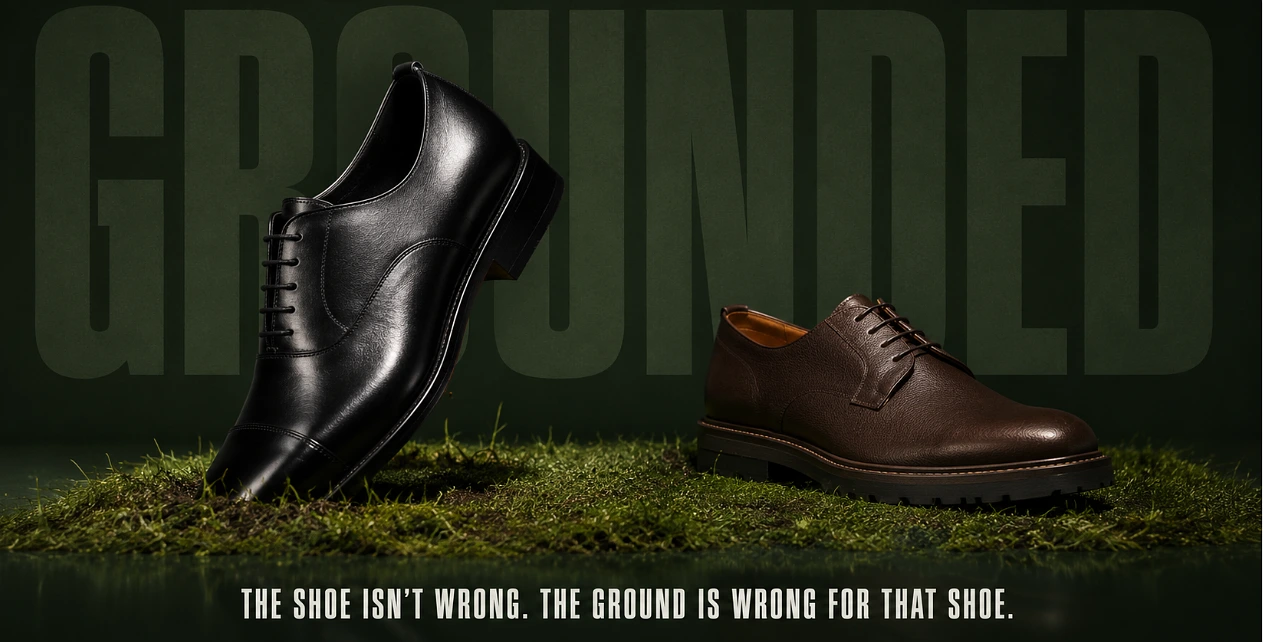
There’s a particular kind of photograph that turns up in nearly every outdoor wedding album, and it’s rarely the one anyone meant to take. A groomsman standing on a lawn mid-reception, one shoe tilted at an angle it was never designed to sit at, because the heel has quietly sunk two inches into ground that looked firm enough from the marquee.
Nobody plans for this. A man reaches for his best Oxfords because they’re his best Oxfords, black calf, leather sole, the pair that’s carried him through every formal occasion for years without complaint, and the same qualities that make them correct for a boardroom or a church aisle are exactly what betrays him the moment he steps off the paving and onto turf. A hard leather sole with almost no tread finds nothing to grip in soft ground, so the whole weight of the shoe, and the man standing in it, goes straight down into the grass rather than across it.
The shoe isn’t wrong. The ground is wrong for that shoe. Most men never learn the difference until the day it costs them.
What actually makes one shoe more formal than another
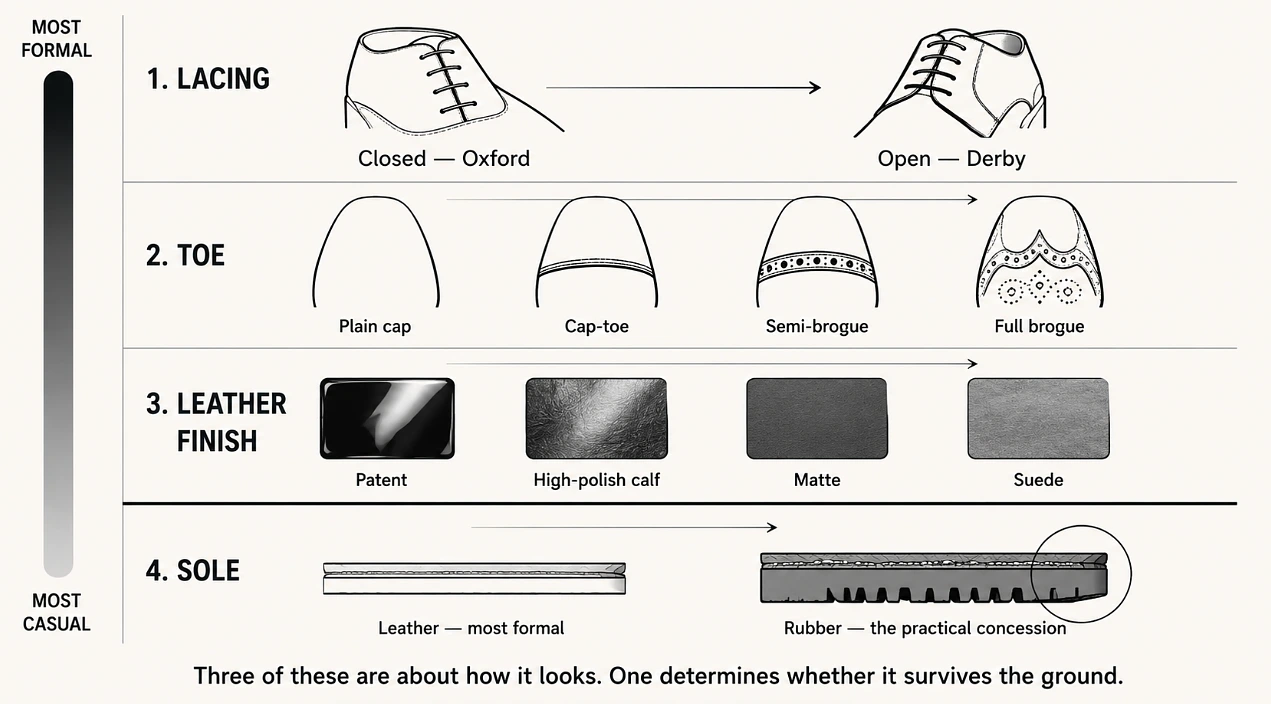
Getting the formality register right starts with four signals, and once you can read them, most dress shoe decisions become fast rather than guesswork.
- Lacing. Oxfords use closed lacing, the quarters stitched under the vamp, which sits higher on the formality scale than a Derby’s open lacing.
- Toe. A plain cap is the most formal, then a cap-toe, then a semi-brogue, then a full brogue or wingtip, each step adding decoration and losing a little austerity.
- Leather finish. Patent sits at the very top, followed by high-polish calf, then matte finishes, with suede at the casual end and largely unsuited to black tie.
- Sole. Leather reads as more formal and produces that distinctive sound on hard flooring. Rubber is the practical concession, and it’s the one variable that actually matters outdoors.
That last point is where the whole grass problem lives. Everything else on that list is about how a shoe looks. Sole material is the one thing that determines whether it survives contact with the actual world.
Why the fix isn’t switching to a casual shoe
The instinct, once someone’s been caught out once, is to swing too far the other way and turn up to the next outdoor event in something rubber-soled and relaxed, and that solves the grip problem while creating a different one entirely, because a monk strap or a loafer doesn’t carry the visual weight a formal dress code actually calls for.
The better answer sits in construction rather than style. A rubber-soled Derby or brogue in a dark, formal leather keeps the visual register correct while giving the sole enough tread to hold on grass and gravel, and this is a case where the right shoe is genuinely a specific, narrower category than most men’s existing wardrobe contains.
What Goodyear welting actually buys you
This is where construction quality stops being an abstract selling point and starts being the entire argument.
A Goodyear welted shoe stitches the outsole to a welt strip running around the upper, rather than gluing the sole directly on. That single detail is why a welted shoe can be resoled repeatedly without ever touching the upper, the part that took the longest to make and fits your foot the way it does. Cemented construction, the method behind most shoes sold anywhere, bonds the sole straight to the upper, and once that bond fails or the sole wears through, there’s no meaningful repair, the shoe is finished.
A professional resole in the UK typically runs £40 to £90, according to the Society of Master Shoe Repairers, and a well-maintained welted shoe can absorb that repair somewhere between three and eight times over its life depending on how it’s cared for, which is how a single pair ends up serving a man for well past twenty years rather than the two or three a cemented pair usually manages before it’s discarded.
That’s the maths a rubber-soled, welted Derby is actually offering, not just grip for one outdoor wedding, but a shoe built to be rebuilt rather than replaced. Brand House Direct Florsheim shoes covers this exact category, welted construction across Oxford, Derby, and casual lines, and ships worldwide including to the UK, so the option isn’t limited by where you happen to be shopping from.
Building toward it rather than buying everything at once
Nobody needs six pairs of formal shoes. Three or four, chosen for genuinely different jobs, covers almost everything a modern calendar produces.
A black Oxford handles black tie and conservative business. A dark brown Derby or semi-brogue takes on most professional and social formal occasions, weddings included, as long as they’re not outdoors. And a rubber-soled, welted Derby in dark leather earns its place specifically for the days the venue is a lawn rather than a floor, which sounds like a narrow use case until the invitation actually arrives and there’s nothing else in the wardrobe suited to it.
That’s a small collection. It just needs to be the right one.