

Blog
Before you pack your things for a trip to Ireland, it helps to know these things if you’re visiting for the first time

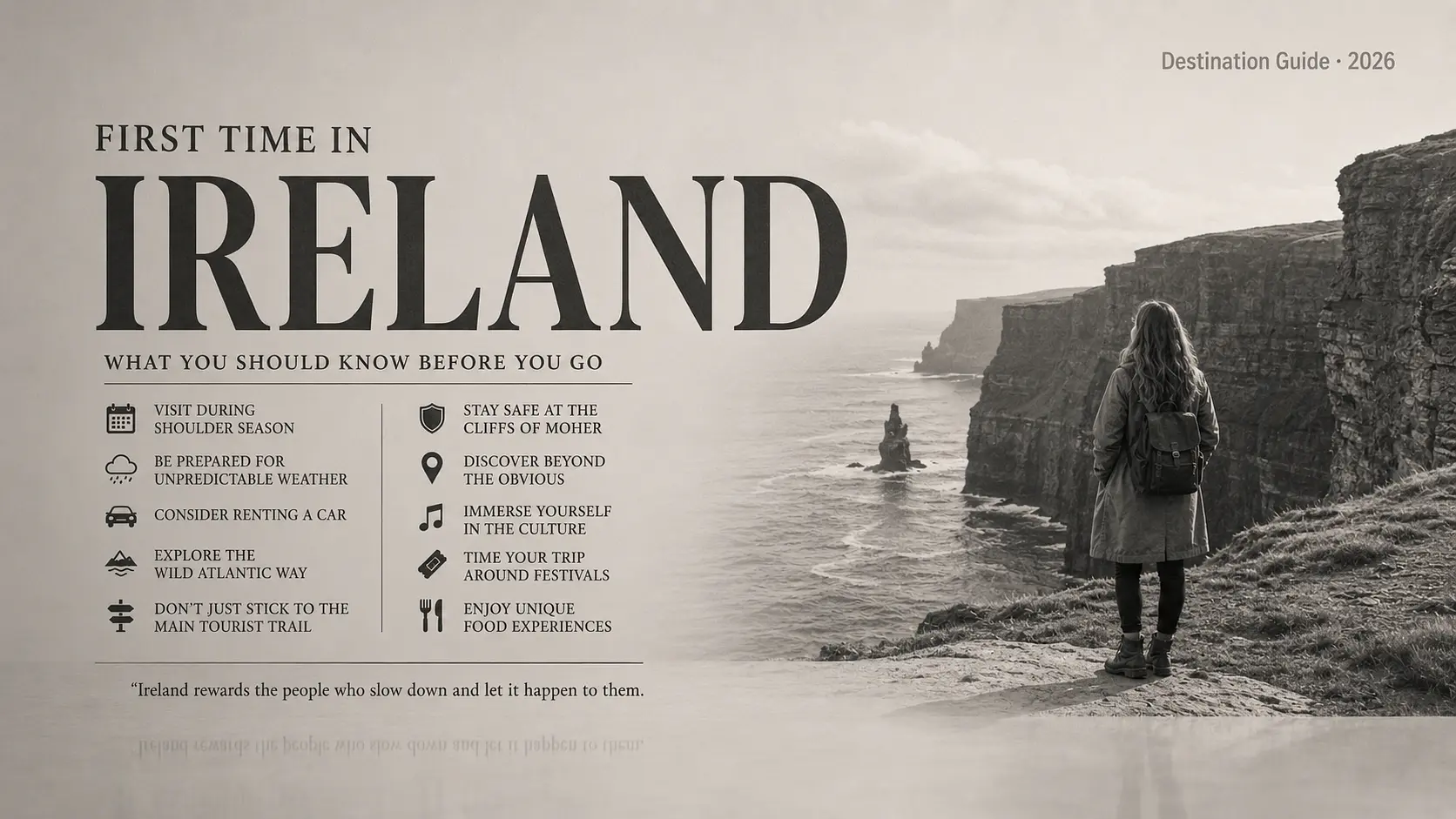
Sheep, magical dark skies, unique food experiences, green rolling hills, and windswept rock formations… these are just some of the things that await you if you’ve decided to visit Ireland this year (by the way, you made the best decision EVER, because Ireland isn’t a destination like any other). It’s, after all, the very territory of Game of Thrones, because much of the smash-hit series was filmed at epic locations like the Cushendun Caves. If you’re a fan of the series, you’ll absolutely fall in love at first sight with Ireland.
But Ireland is a place that has many other things to offer. You can go castle hunting, hiking, stop in quaint fishing villages, enjoy music festivals, and dig your teeth into the popular Irish soda bread… you get the idea. To make sure your trip goes as smoothly as it possibly can, there are a few things you should know if this is your first time visiting Ireland.
Visit during the shoulder season
Travelling to Ireland in the summer, when tourism is at its highest, is not the same as travelling there in the winter. Generally speaking, July and August are the busiest months, so you’ll probably pay more if you go during that time (also, it’s crucial to reserve your hotel in advance). Because rates are lower and attractions aren’t as busy during shoulder season, which runs from April to June and September to October, it would be a smart idea to visit during these times.
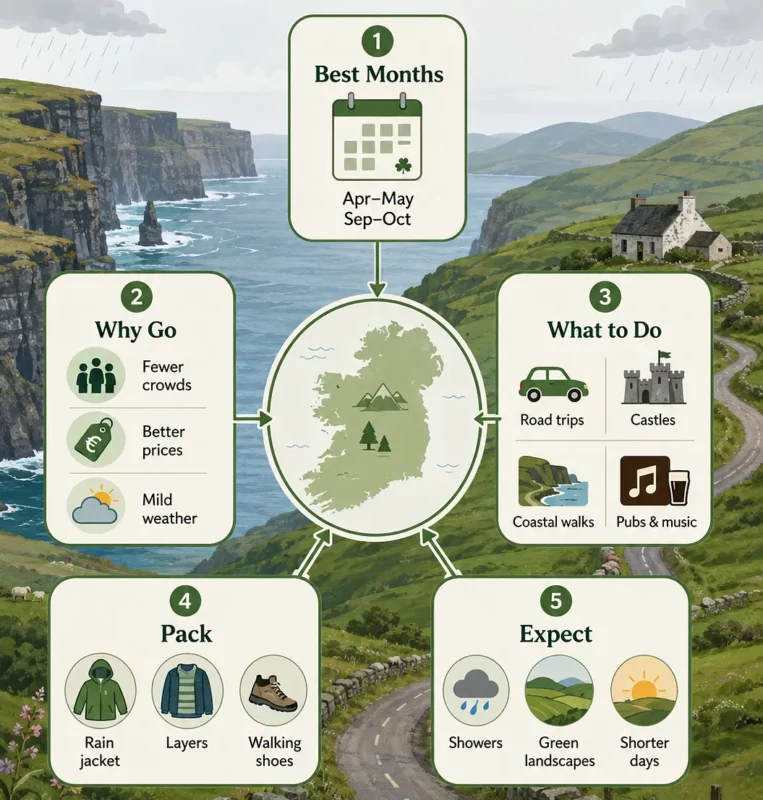
So what about the weather during shoulder season — is it actually bearable?
To be honest, it’s better than you may anticipate. The countryside is at its greenest, there are more daylight hours in April and May, and there are frequently days that are actually warm mixed in with the wet ones. Photographers travel specifically for the autumn light that arrives in September and early October. The weather is still suitable for the majority of activities you want to do, so don’t worry too much about it.
What if you visit in winter
If you want to travel to Ireland during the winter, you should be aware that some of the country’s rural attractions may have restricted hours or be completely closed. However, you will still be able to experience big sites because they are often open. Proper bar fires, fewer people at the major sights, and substantially lower lodging costs outside of the holiday season are all benefits of the gloomy winter evenings.
Be prepared for the unpredictable climate
Ireland is well known for its erratic weather. It can be sunny and brilliant one minute and windy and wet the next. We know it’s not very convenient. However, you shouldn’t let the weather keep you from travelling to Ireland.
Being prepared is helpful, and you can achieve this by packing layers and keeping a raincoat or travel umbrella close at hand. When packing, bear in mind that it may rain in Ireland, even on bright days.
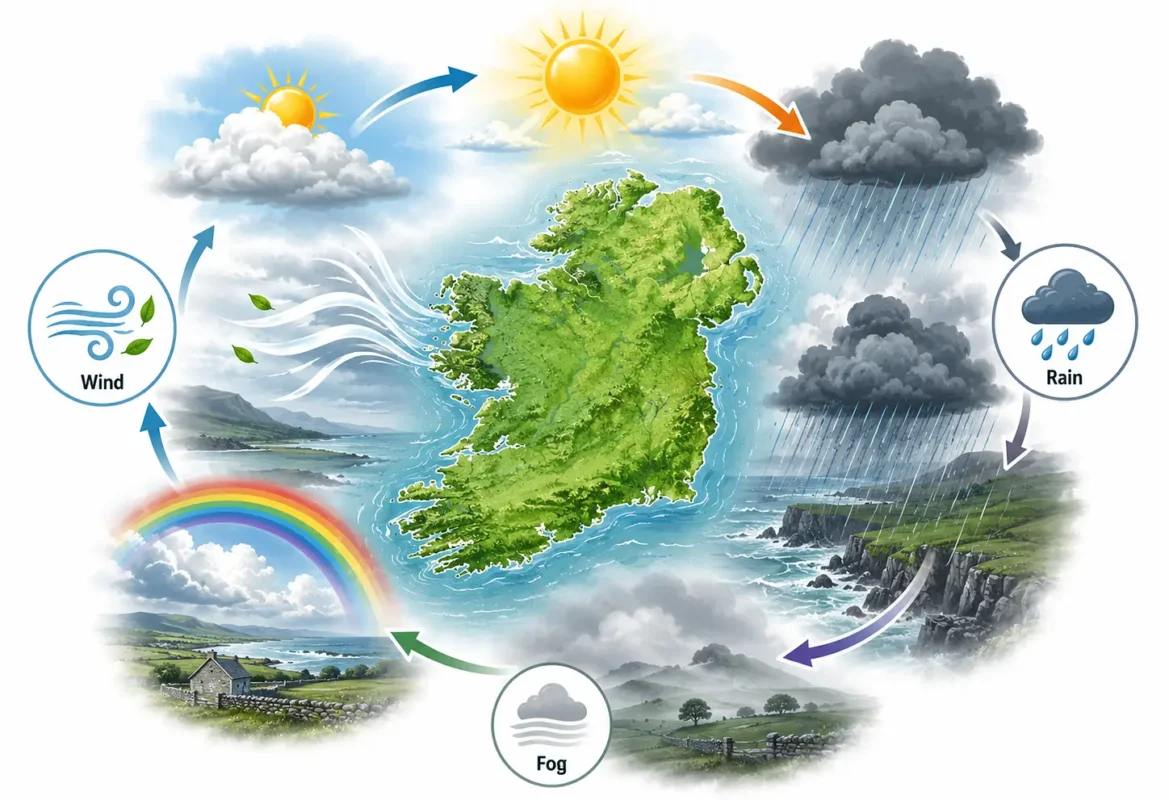
Is there any forecast you can actually trust?
Locals will tell you to check Met Éireann — the national weather service—the night before any outdoor day, but they’ll also advise you not to trust the forecast more than 12 hours in advance. The majority of weather apps operate using algorithms that have trouble with Ireland’s microclimates, and The Atlantic does as it pleases. The closest thing to accuracy is Met Éireann’s own short-range forecast.
Planning your days around the weather
You’ll need to be adaptable with your activities in addition to packing. It makes sense to plan outside activities during the morning as it’s usually clearer. In the end, it’s important to have a positive outlook because Ireland’s variable weather is part of the pleasure. Ireland is initially green and lush because of the rain.
Consider renting a car
Yes, you could travel throughout Ireland without a car. Trains and buses are excellent forms of public transportation, and you can take a trip to see the nation’s major attractions. However, you should be aware that this option will limit your flexibility, which is why we advise hiring a car.
After all, the best parts of your trip will be finding a pub in a random country village, doing a slow drive along the Wild Atlantic Way, or stumbling upon a castle that’s set against green rolling hills. These spontaneous adventures are much easier with a car, and the roads in rural Ireland are very scenic, even if some of them are narrower than you’d expect.
Why the Wild Atlantic Way is worth building your trip around
What’s the Wild Atlantic Way and why is everyone going on about it?
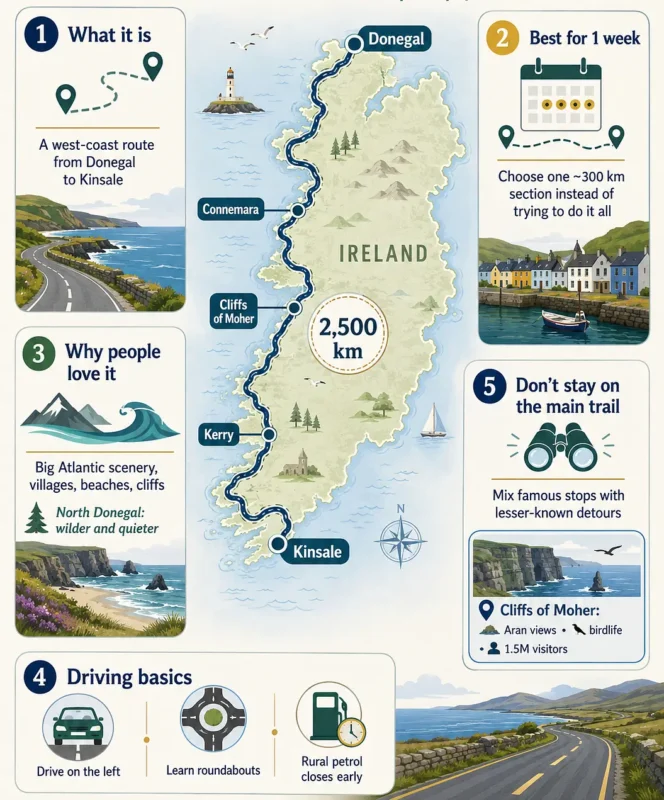
It stretches 2,500 km from Donegal in the north to Kinsale in Cork, covering the whole west coast. For the past few years, Failte Ireland has been subtly promoting this route as the primary road trip experience in the nation. If you just have a week, choosing a 300-kilometer portion of it will make your journey far more enjoyable than trying to do everything. The northern parts of Donegal are perhaps more dramatic and less visited than the more well-known Connemara or Kerry areas.
A few practical driving notes
Nonetheless, spend some time learning the laws of the road and how to handle roundabouts if you’re driving in Ireland. Many avoid this, and when they get at the first multi-lane roundabout outside of Dublin, they become frightened. You’ll thank yourself later, even if it seems dull at first. Petrol stations in rural areas close sooner than you might anticipate, and driving is on the left.
Don’t just stick to the main tourist trail
There is a reason why certain locations in Ireland are popular with tourists. For instance, the Cliffs of Moher provide a breathtaking view of the Aran Islands and are a popular destination for birdwatchers in particular. The first time you stand at the edge of a 700-foot vertical drop with the Atlantic slamming below, you may understand why they attract about 1.5 million tourists annually.
The Cliffs of Moher safety situation in 2025–2026
How dangerous is the trail, actually?
more hazardous than most travel guides claim. According to a research published in the Journal of Travel Medicine, 66 people died at the cliffs between 1993 and 2017. Three more people died along the Coastal Trail in 2024 alone, including a 20-year-old Belgian medical student and a 12-year-old youngster. Large portions of the 20-kilometer Cliffs of Moher Coastal Trail have been closed throughout 2025 and into 2026 due to a safety audit conducted by Sport Ireland. The trail, together with Carrauntoohil, is officially categorised as Grade 5, which is the hardest walking grade in Ireland. While the larger Coastal Trail is closed, the Visitor Experience platforms are still open and securely fenced.
In July 2025, the Irish Times revealed that visitors were scaling the gates and tearing down portions of the wall to get to the trail’s closed sections. Avoid becoming one of them.
What if something does go wrong while you’re travelling?
Accidents do happen at tourist sites, even where everyone has behaved sensibly — slips on wet steps, rental car incidents, hotel injuries that weren’t your fault. If you find yourself injured in Ireland through no fault of your own, it’s worth knowing your legal rights as a tourist in Ireland before you need to. The law on public liability is reasonably protective of visitors, but the principle of personal responsibility applies, and the warning signs at the cliffs are there for a reason.
Where to go beyond the obvious
Even though the Cliffs of Moher are a must-see, we advise you to venture off the usual route because there is much more to explore outside of the well-known locations. It’s unfortunate that most Ireland itineraries omit the Mourne Mountains in County Down, the Beara Peninsula in Cork, and the North Mayo coast. In actuality, the Slieve League Cliffs in Donegal are a small portion of the Cliffs of Moher and almost three times as tall. The blend of peace and natural beauty truly shines in these less-traveled areas of Ireland.
Look beyond pubs and immerse yourself in the culture
Looking past the clichés is one of the most crucial pieces of advise we can provide someone visiting Ireland for the first time. Pubs are undoubtedly a part of Irish culture, but it goes beyond that. Irish customs are deeply ingrained in literature, athletics, music, and storytelling, and you are free to fully immerse yourself in the culture whichever best suits you.
Where locals go in reality
You’ll gain a true sense of the place in this way. Take part in the activities of the locals, such as attending a GAA match on a Sunday afternoon at a small parish ground or listening to live trad at The Cobblestone in Dublin or Tigh Cóilí in Galway.
What is a GAA match, and is it worth attending?
No tourist pub session can provide you with a view into Irish identity like Gaelic football and hurling, the two main GAA sports. In particular, hurling is worth seeing once in a lifetime. The energy at a county-level match is unlike anything else in European sport, and it’s the oldest field game in the world. It’s played at incredible speed with a wooden stick and a little leather ball. At the local club level, tickets are inexpensive or free, and the vibe is authentic.
Timing your trip around festivals
If you can, it’s also a fantastic idea to schedule your trip around festivals. You will like Kerry’s Puck Fair, which is one of the nation’s oldest and most distinctive fairs. Bach’s Brandenburg Concertos have been performed by Chamber Music on Valentia in the past. There are dozens of festivals all throughout the nation, ranging from traditional music events in little Donegal townlands to literary weeks in small Connemara villages, so it’s worthwhile to check what’s going on when you’re making travel plans. Tourism Ireland keeps a fairly comprehensive listing.
On the question of cost
Additionally, don’t worry about being bankrupt. Ireland is known for being pricey, and Dublin can be, but if you spend a week in the west and stay in bed and breakfasts in towns like Westport, Dingle, or Clifden, you’ll discover that the price is fair for what you get. Over the past ten years, food has significantly improved, especially outside of cities. For a third of the price, you can dine better at a modest Connemara pub than in many upscale Dublin restaurants. Look for establishments that use local fish, lamb, and farmhouse cheeses.
Those that slow down and allow it to happen to them are rewarded in Ireland. Don’t attempt to do everything, plan the structure, and allow time for the days. You’ll return.