

Blog
Do You Know Laser Eye Surgery In Britain Began On The Wards Of One London Hospital


Over Winchester on 15 August 1940, a cannon shell burst through the hood of Gordon Cleaver’s Hurricane and filled his eyes with splinters of Perspex. He had flown that morning reportedly without his goggles, and although he managed to bale out and was brought down to hospital alive, the right eye was lost and the left kept only part of its sight. Eighteen operations were needed in the years that followed, yet slivers of the shattered hood stayed buried where no surgeon of the day could safely reach them.
When The Splinters Would Not Inflame, An Idea Took Hold
Among the surgeons who treated such airmen was Harold Ridley of St Thomas’ Hospital, and he noticed something his training had not prepared him for: the slivers of Perspex lay quietly in the eye, light and inert, provoking none of the fury that glass or metal would have raised. When a medical student later remarked that it seemed a pity the cataract he had watched being removed could not be replaced with a clear lens, the remark and the wartime observation joined together in Ridley’s mind. In strict secrecy he set to work with John Pike, an optical scientist at Rayner, and John Holt of ICI, until a clinical grade of the material had been prepared under the name Perspex CQ. At St Thomas’ on 29 November 1949, the first implant operation was performed upon a 45-year-old woman, and an artificial lens entered a human eye for the first time anywhere.
His Peers Condemned The New Lens Out Of Hand
Secrecy of that kind could not hold forever, and when news of his work leaked out, the profession received it with something close to horror. He was accused of gambling with patients’ sight, his lens was condemned out of hand, and the condemnation stayed on him for decades. “There are none so blind as those who will not see,” runs the old proverb, and seldom has it fitted a learned body so neatly. Acceptance came slowly, through his pupil Peter Choyce and through surgeons abroad, until the operation he had been scorned for became one of the most common in medicine. He was knighted in 2000, when lenses of his design had already been placed in his own eyes, and he died the following year at 94, having lived to see it all.
Forty Years On, The Laser Arrived At The Old Address
By the time the next revolution in sight came round, the hospital’s part in it was already prepared, for Professor John Marshall, who came to hold the Frost chair of ophthalmology at St Thomas’, had patented a method in 1986 for reshaping the cornea with the excimer laser. In November 1989 the first laser eye treatment in Britain was carried out at that hospital by David Gartry, then a research fellow of the unit. Forty years, almost to the month, separated Ridley’s first implant from Britain’s first laser correction, and one London hospital stood at each end of the line. From that beginning the treatment moved out to the high street and became an everyday matter.
Choose Today’s Clinic With The College’s Checklist In Hand
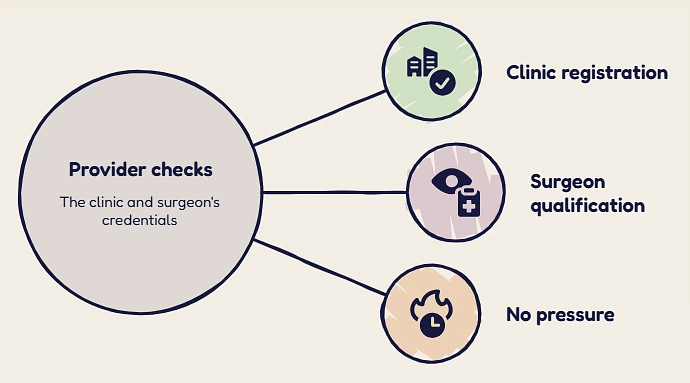
A reader weighing the operation now stands at the far end of that line of descent, and the choosing deserves patience of the kind Ridley gave his lens. The Royal College of Ophthalmologists keeps a plain patient checklist for exactly this decision:
- The clinic should be registered with the Care Quality Commission.
- The surgeon’s name belongs on the GMC specialist register for ophthalmology, unless he holds the College’s own certificate in laser refractive surgery instead.
- No pressure to consent ought to be accepted, however loudly a time-limited offer may tick.
Fellowship training in cornea and refractive surgery has become the expected path for those who perform these corrections, and consultant ophthalmic surgeons of that formation, Mr Jeremy Hoffman at one of the best laser eye surgery clinic in UK among them, now practise openly the trade that Ridley’s generation was mocked for imagining. Provided that the checklist is satisfied and the consultation unhurried, the final choice between good clinics may safely rest on comfort and trust.
Cleaver never flew again, and Ridley waited half a century for his due. A reader today need only check a register and decline to be hurried, and that is a small discipline beside theirs.