

Blog
Hedgehogs Start Bedding Down This Month In The Parts Of The Garden A Basic Robot Mower Cannot Handle

A hedgehog in an English garden will start bedding down this month or next, in a nest of leaves it has been pulling together since the nights turned, and some will still be out in December if the weather stays mild, but the spot will have been picked by one rule, which is that nothing comes through there. The robot mower guides going round this autumn open on a list of the bits a basic machine cannot cope with, separate lawns, narrow passages, trees, flower beds, slopes, toys left out, and the list is correct, and every item on it is somewhere a hedgehog sleeps.
Hedgehogs in the countryside are down by somewhere between 30% and 75% since 2000, on the PTES and British Hedgehog Preservation Society count, and the ones in towns are holding up better, which puts the back garden, and whatever runs across it at night, in the middle of the conservation effort.
Bar One Instance, Every Mower In The Oxford Test Had To Touch The Hedgehog To Notice It
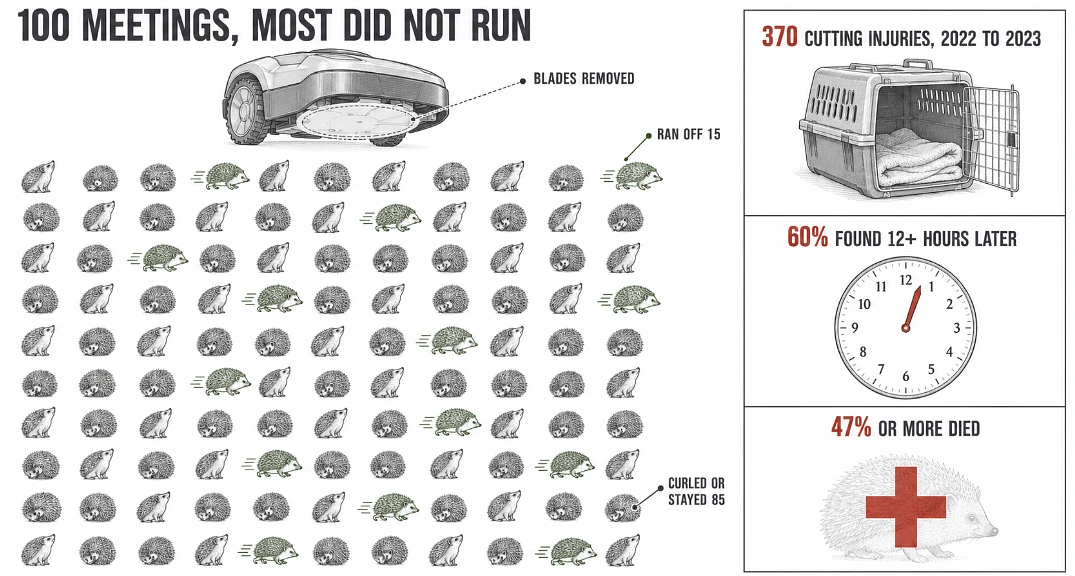
Dr Sophie Lund Rasmussen at Oxford has been running robot mowers at hedgehogs since the first paper in 2021, dead ones first, with a 3D printed dummy designed off the back of it for the manufacturers to test with, and the January 2024 paper covered 19 models on sale in Europe. Bar one single instance in all the runs, the 19 had to physically bump the hedgehog before any of them registered it was there, and some rolled over it without registering it at all. The worst cases went straight over with the blades still turning.
Live hedgehogs came next, 50 of them, watched by the same team meeting a mower with the blades taken off at a rescue centre in Denmark, and most of them did not run. In 15 of the 100 encounters the hedgehog ran off, and the rest curled up, or stood there and sniffed at it, and the adults were shyer than the young ones, and a hedgehog that had met the machine once was more careful the second time, which is cold comfort because the second meeting is usually the one in the dark with the blades on.
A separate German count published in the same issue, led by Anne Berger in Berlin, took in 370 hedgehogs brought to rescue centres with cutting injuries from electric garden kit between June 2022 and September 2023, strimmers and the like included, and the timing of the injuries, which hour and which months they came in, pointed the researchers at robot mowers for many of them without proving it case by case. At least 47% of them died, and at least 60% had been found more than 12 hours after the injury, some not for days or even weeks, and that is how an owner never knows, the mower goes back to its dock and the lawn looks cut.
Hedge Bottoms, Leaf Piles And Long Grass Under Trees Are Where They Nest
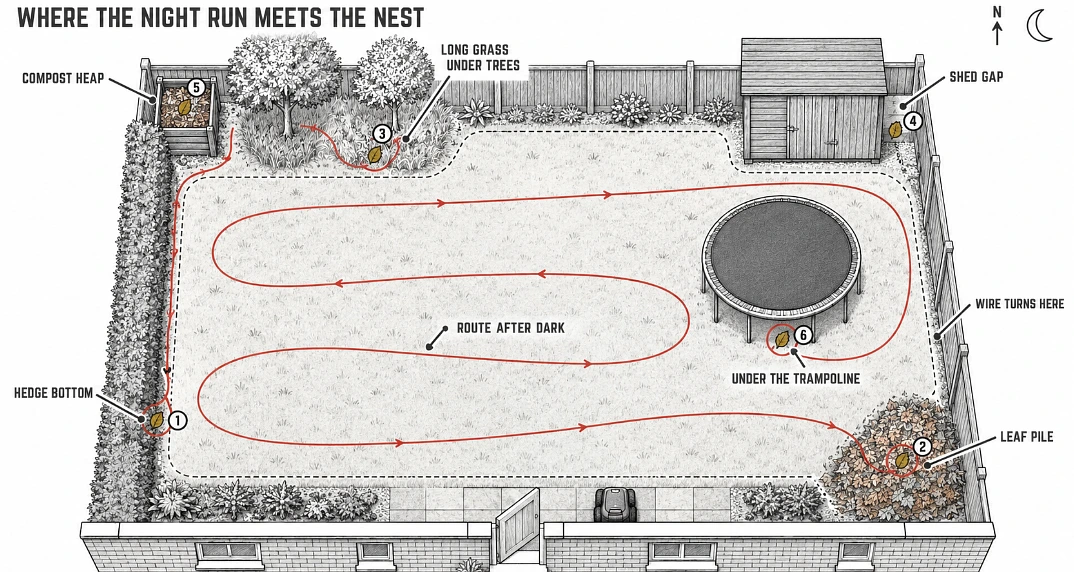
By late October the nest is built from leaves and it is built where the leaves are, so the places a garden gets complicated for a mower are the places a hedgehog has already chosen, and it will stay there until March or April if the winter is cold, and wander in and out of it if the winter is mild.
- Under the hedge and along the fence line, where a wired mower follows the cable to within a few centimetres and turns, and the turn is the bump.
- The leaf pile in the corner that was meant to go to the tip, which the mower might take for lawn edge and nose into.
- Long grass under the trees, where the deck is already set low because of the roots, and a curled hedgehog is about the height of the grass.
- The gap between the shed and the fence, the narrow passage every guide warns about, which a hedgehog uses as a road every night.
- The compost heap and the ground under the trampoline, both on the mower’s route when it is set to run after dark.
Knowing where the mower goes at 11 at night matters more than any of that, and most owners could not say without opening the app.
A Boundary Wire Cannot See An Animal, That Takes A Sensor On The Mower
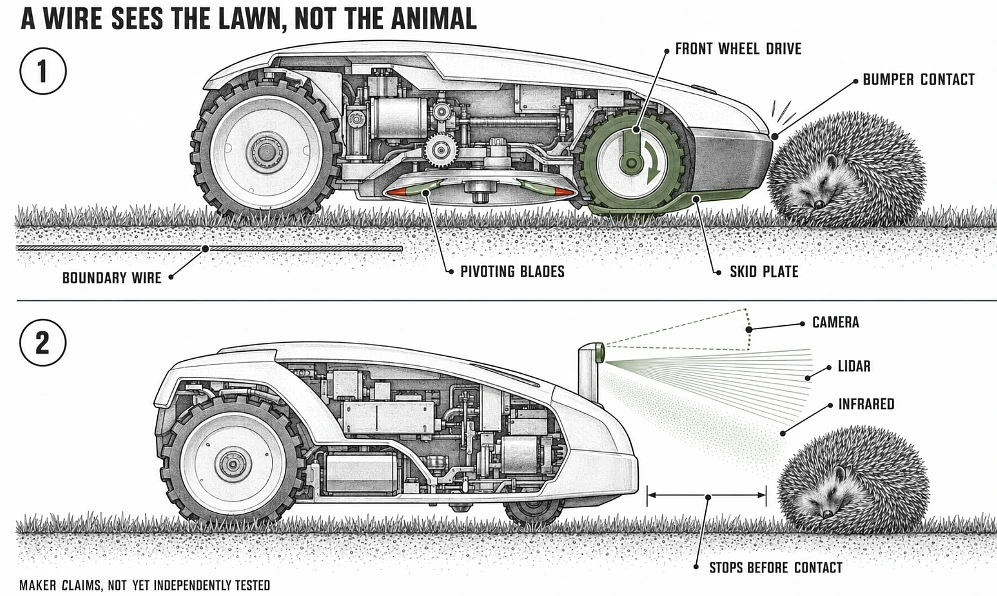
A boundary wire tells the mower where the lawn stops and that is all it tells it, so unless the mower has something else fitted, and most of the older wired ones have nothing else, it finds a hedgehog the way a hoover finds a sock, by running into it. A wired Husqvarna Automower of the kind Garden Machinery Direct in Worcester stocks ships with pivoting blades and a skid plate, which are 2 of the 3 features the 2021 round of the Oxford test found did reduce the damage, the third being front wheel drive, and the newer 405XE NERA on the same shelf has a radar on it for objects, while a STIHL iMOW 5 next to it has the pivoting blades and no skid plate, which is how the 2024 paper’s own table lists it.
Cameras have been going onto the wire free models for 2 years now, and in September at IFA in Berlin, Anthbot showed an R7 with an infrared sensor put there for animals, to pick up body heat in the grass before the bump, alongside the cameras, RTK positioning and LiDAR the wire free machines already carry. No UK price or UK date has been announced for it. Segway Navimow showed its own at the same fair, the H5 Pro, with a camera, LiDAR and an infrared sensor as well and an arm for the edges, and that one is down for early 2027. The direction is clear enough, the new ones are built to pick the animal up before the bump, on the makers’ word so far because no independent test has been run on them with the hedgehog dummy, and a wired mower with nothing added to it never will, because there is nothing on it to see with. It would be unfair to call a wired mower a danger on every lawn, because one set to run at 2 in the afternoon on an open lawn with the hedge wired out will not meet a hedgehog, the hedgehog being asleep under the hedge the mower cannot reach. The risk comes from the hours it runs, and those are set in the app.
Daylight Only And A Walk Round First Is The Hedgehog Street Advice
Hedgehog Street, which is the British Hedgehog Preservation Society and the People’s Trust for Endangered Species together, asks 2 things of robot mower owners: run it in daylight only, and look over the grass before it starts.
Daylight is the rule that slips, because the mower is quiet and the lawn is free at night and the app will happily take an evening slot, and a hedgehog is out from dusk, so a mower set for 9pm is out at the same hour as the animal it cannot see. The researchers behind the German count went further and asked for a ban on night running, and the Oxford paper asked for the hedgehog dummy test to be part of the approval every mower goes through before it is sold. Hedgehog Street reported last summer that the European Garden Machinery Federation was due to take the test on, and the federation’s own 2025 report has a task force drafting a voluntary standard and talking about a hedgehog friendly label, and as of this month nothing final is published on its standards page.
Walking the lawn first takes 2 minutes and it is the same walk a person does before strimming the long grass, hedge bottom, leaf pile, under the trampoline, and in October it is also the walk that finds the nest before the mower does. If you find one, the advice is to leave it alone, because a hedgehog woken in hibernation burns the fat it needed to get to spring, so the mower’s wire or map gets moved and the hedgehog stays where it is.
Slopes, Ponds And Narrow Passages Still Get Measured With A Tape, Whatever The Mower
Everything else on the usual list is still true and none of it has anything to do with hedgehogs. A passage barely wider than the mower will stay a problem with a wire or a camera and the fix should be a tape measure at the narrowest point before anyone buys, a pond needs a boundary with margin in it because a navigation error there costs the mower, and a slope has a gradient limit printed in the manual that a wet October makes stricter.
Open the app tonight and look at the hours the mower is set to, and if any of them fall after dusk, move them into the day, and before the first frost get down and look under the hedge, because by then the nest will be there whether the mower knows about it or not.