

Blog
How Magazine Publishers Are Turning Print Articles Into Audio With Text to Speech

The first article I ran through a text to speech tool was a buying guide. It came back sounding like a train announcement reading out a receipt. Every price, every model number, every bracket, straight down the line in the same tone.
I almost stopped there. What kept me going is that the archive is already paid for, and audio is the only format left where you can publish a hundred pieces without writing a hundred pieces.
UK Podcast Reach Is 27% of Adults, and News Is the Biggest Genre
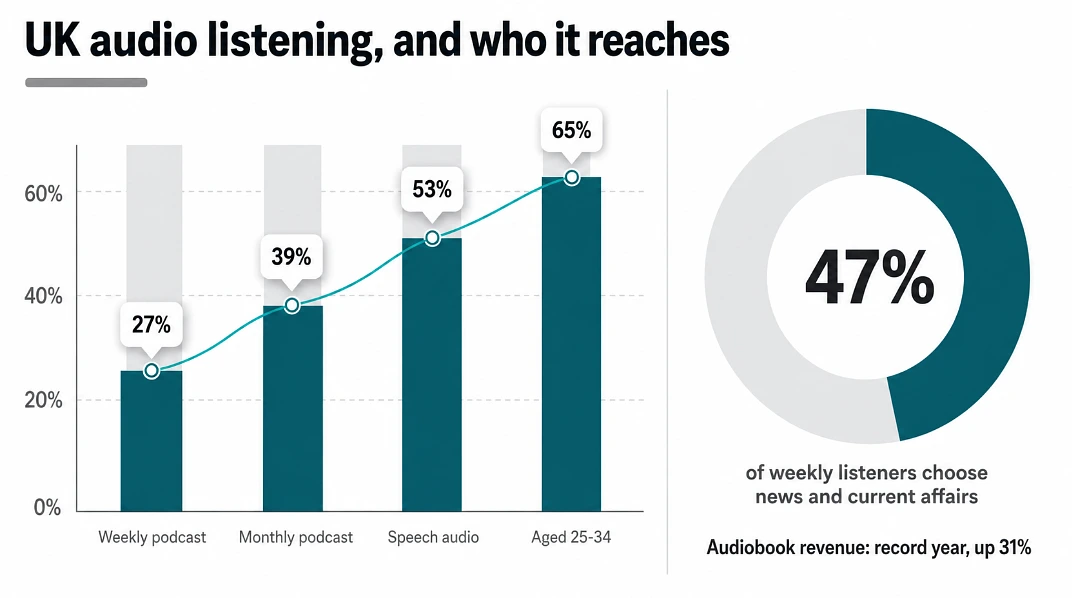
Ofcom’s 2026 audio report has weekly podcast reach at 27% of UK adults, up from 23% the year before. On a monthly measure, Media Nations 2026 takes podcast listening from 18% in 2019 to 39% now. Speech audio reaches 53% of adults, and 65% of 25 to 34s.
Audiobooks went the same way. UK revenue hit a record £268 million in 2024, up 31% in a year, with a fifth of adults listening.
Then the figure that decides whether any of this is your business: 47% of weekly podcast listeners pick news and current affairs. Not comedy, not true crime. That audience is already showing up for editorial.
Your Listener Is at Home, Not in the Car
Every audio pitch says commuting. Ofcom’s in car figures say live radio takes 71% of in car listening and podcasts take 4%.
The car belongs to radio. What you are aiming at is somebody at home with one earbud in, doing something else, on their own. Ofcom found more than twice as much listening time is spent alone as with other adults.
Strip the Page Furniture Before You Convert Anything
This is the step I wish somebody had told me about, because missing it cost me a fortnight.
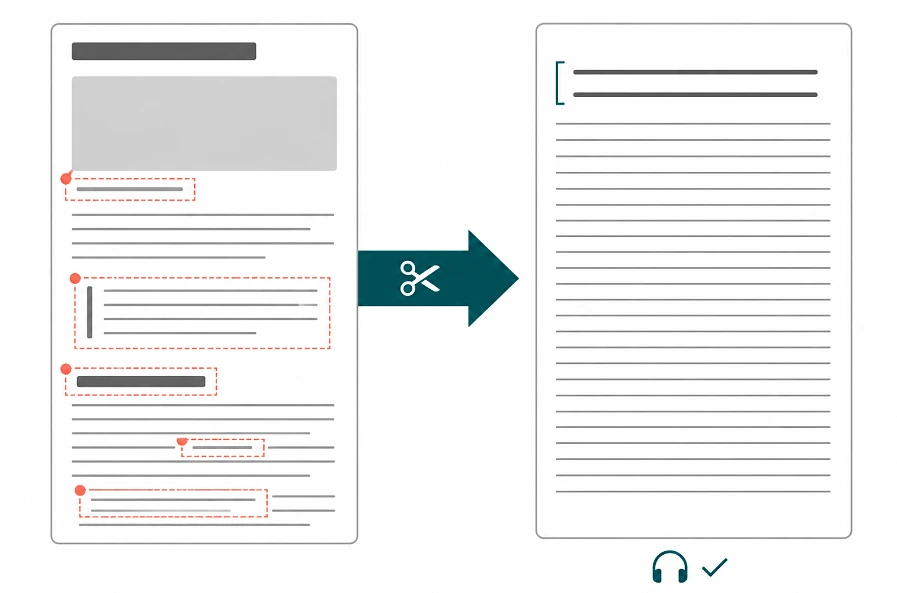
An article on a page is not a script. Pull quotes get read out mid sentence. Image captions arrive from nowhere. Subheadings land as sentences. “As we covered above” means nothing to somebody who arrived through Spotify. Product names get mangled, and if your buying guide lists fifteen brands, four of them will come out wrong.
So the workflow has an extra step in it:
- Copy the article into a plain document and strip the furniture. Captions, subheads, pull quotes, cross references.
- Rewrite the opening two sentences for a listener. They have no headline in front of them.
- Run it through a text to speech tool and generate the audio.
- Listen to all of it once. Fix the names phonetically and regenerate.
- Publish twice, as a podcast episode and as a player on the article page.
Step four gets skipped constantly. Ten minutes in headphones catches everything.
Use One Voice Per Section and Keep It
Lifestyle gets one voice, business gets another. Listeners learn a voice the way they learn a magazine section, and swapping it every month throws that away.
Interviews and Roundups Convert Best, Comparison Tables Do Not
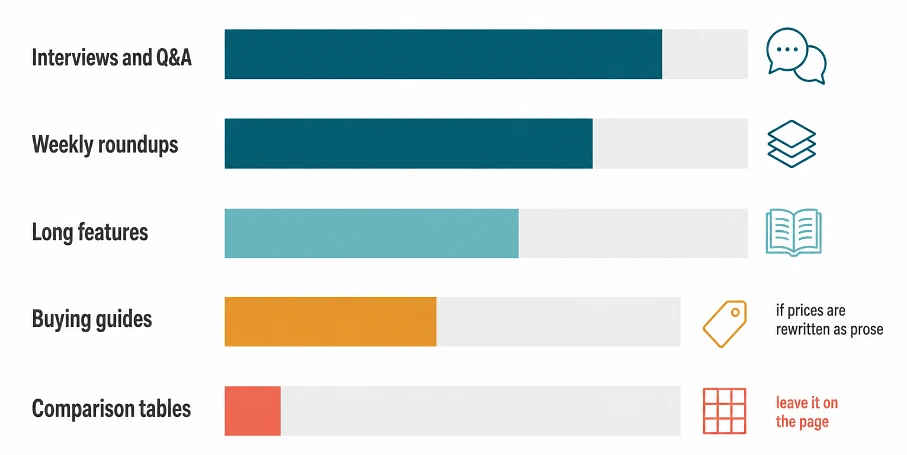
Interviews come out strongest, because a Q and A is already a conversation. Long features work too, mainly because those are the reads people save and never return to. Weekly roundups become a recurring episode, which over a year is worth more than any single hit.
Buying guides can work once you rewrite the price sections into prose. “Two hundred and forty pounds” is fine aloud. “£239.99, RRP £280, currently reduced” is not.
Anything built on a comparison table, leave it. If the reader has to see it, a voice will not save it.
A Talking Avatar Gives You the YouTube and Reels Version
Audio does nothing for Instagram or YouTube. A cover image with a moving waveform is not a video, and the algorithms treat it as such.
A talking avatar puts a presenter on screen delivering the same script, lip synced, without your features editor sitting in front of a ring light on a Thursday afternoon. The script you cleaned up in step one feeds straight into it. One edit, three outputs, and video podcasts are climbing in the same Ofcom data as everything else here.
Publishing Is Free, Being Found Is Not
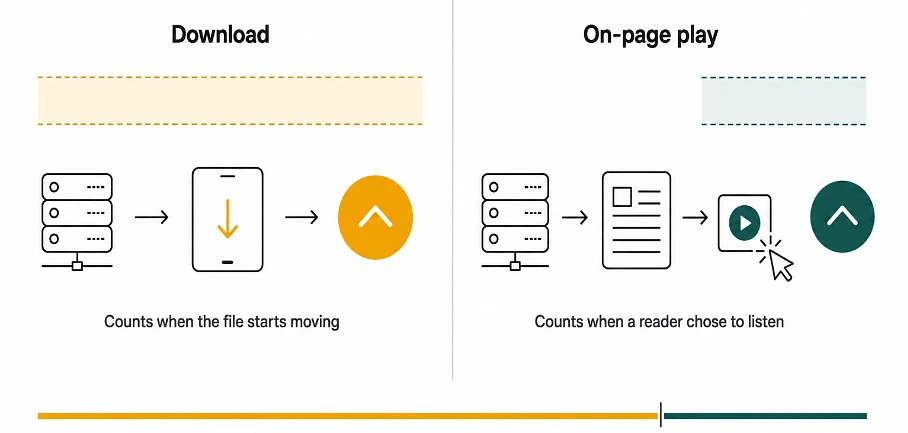
Free to publish and free to be found are two different things and the pitch decks blur them constantly. The Podcast Index counts around 4.4 million active podcasts, up 38% from 3.2 million in 2024, with roughly 85,000 new episodes a week dropping into the same directories yours does. So a publisher who launches a feed, tells no one, then checks the numbers a fortnight later is going to decide audio does not work here, when what happened is they published into a search box with no signal behind it. The feeds that get somewhere lean on channels the publisher already owns. Newsletter carries the episode. Article page carries the player. Socials carry a ninety second clip. Your own readers listen first, the platforms notice people finishing episodes, and discovery follows from that rather than arriving before it. Underneath all of this sits a measurement problem as well. A download registers when the file starts moving, so it flatters you. A play on the article page only happens when somebody who was already reading chose to listen instead. Those two numbers will tell you completely different stories about the same piece, so decide which one you are judging the pilot on before you start, otherwise you will find a way to call it a success either way.
Run the Pilot Over Four Weeks and Commit One Category
- Week one, convert your five best evergreen pieces and embed the players.
- Week two, launch the feed with those five and leave it for seven full days. Looking on day two tells you nothing.
- Week three, make avatar versions of the two strongest. One to YouTube, one cut for Reels.
- Week four, compare on page plays, downloads and video views, then give a single content category a permanent audio slot. One category done properly beats five done whenever somebody remembers.
The writing exists. The editing exists. The audience exists. The recording studio was the only thing in the way, and that bill has gone.