

Blog
Refurbish, Refinance, Repeat: Where Investors Get The Sequence Wrong

The refurbish-refinance cycle is the closest thing property investing has to a money machine.
Purchase an ugly house. Renovate. Refinance new, higher value. Strip out cash. Repeat.
Yep, it works. Thousands do this same loop every year right here in the UK. But loads of them still get stuck, sitting on a completed property, watching the bills pile up, wondering how the deal looked so much better on the spreadsheet vs. their bank account.
The strategy is almost never the problem. But it is the sequence that tends to be wrong, and most investors do not realise that until the bills have already started compounding.
How The Refurbish-Refinance Loop Really Works
The model is simple enough to explain in one breath.
The investor purchases a house that would not be touched by any high street mortgage lender, no kitchen, damp walls, possibly even no bathroom. Short term facility is used for purchase and sometimes part-funding of the works. Property is renovated, revalued higher and then refinanced onto a longer-term mortgage product. Short term loan is repaid in full.
Short-term funding is what makes stage one possible in the first place, because without it the purchase would have to wait for a high street lender who is never going to approve a property with no kitchen. Investors rely on speed focused bridging loans because they close in weeks rather than months. Plus, the interest typically does not have to be paid monthly while the property sits vacant earning no cash flow. That is called rolled-up interest. It accumulates silently over time and is repaid in one lump sum at the end, out of the refinance or sale.
Rolled-up interest is what allows the entire refurb model to be feasible for cash-strapped investors.
It is also the feature that catches the most people out.
What Rolled-Up Interest Actually Costs You
Most investors understand the headline rate. Far fewer understand the shape of it.
Serviced interest means you pay monthly and your debt remains flat. Rolled-up interest means you pay nothing monthly but your balance increases. Month 2 rolls interest charges on a larger number than month 1. Month 3 is even larger.
It compounds, and if the project has overrun by even 2 months, it compounds against you in a way that would not have been obvious from the rate sheet on day one.
To put some real numbers on it, because most articles about bridging never bother to. Say the facility is £200,000 at 0.85% per month.
| Month | Balance At Start | Interest That Month | Total Accrued Interest |
| 1 | £200,000 | £1,700 | £1,700 |
| 6 | £208,567 | £1,773 | £10,362 |
| 12 | £218,254 | £1,855 | £21,254 |
| 18 | £228,706 | £1,944 | £32,706 |
If the project had finished on time at month 12, the interest bill would have been around £21,254. But if the builder has overrun by even 6 months, which is not unusual when councils are involved or when materials have been delayed, that figure would have climbed to roughly £32,706. That is an extra £11,452 of cost that did not exist in the original spreadsheet, and none of it came from buying anything or improving anything, it just accumulated because the clock was still running.
12 month numbers on a facility look manageable. Extend that facility to 18 or 20 months because the builder sat on his hands or the surveyor did not agree with your estimates, and your redemption statement suddenly looks very different than what you modelled at inception.
Your overdue balance is accruing interest while it sits there, and at the same time it is also eroding the equity you were relying on for the refinance. Each additional month of capitalised interest becomes another month where the LTV ratio has inched higher, even though the value of the property has not moved at all.
On top of that, lenders have been tightening up. Data from the BDLA shows that the average LTV dropped in Q1, and when you look at what that means for a real deal the picture is not encouraging:
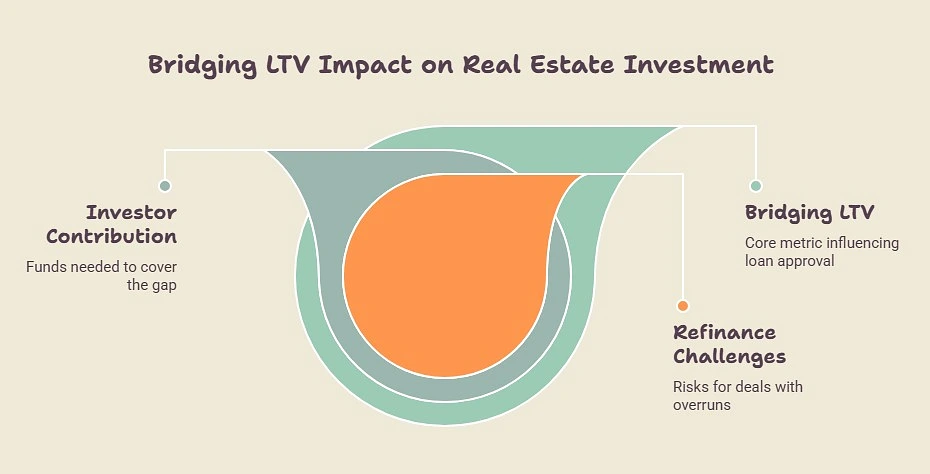
- Average bridging LTV in Q1: 56.64%, down from 58.64% the previous quarter.
- What 56.64% means in practice: the lender would only be willing to cover just over half the property value, so the investor needs to bring nearly half themselves, whether that is in cash or in equity from the uplift.
- For a deal that has already overrun: if the rolled-up interest has eaten into the equity, even a small LTV tightening could be enough to push the refinance out of reach.
Less leverage means less room for a deal to slide before the maths would stop adding up.
The Three Sequencing Mistakes That Wreck Returns
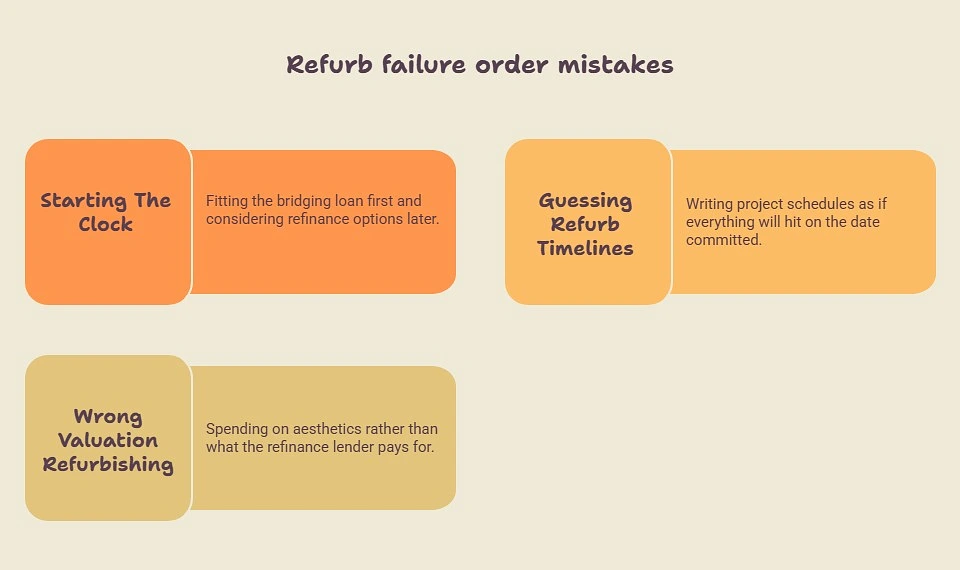
You can attribute almost all stuck refurb failures to one of these 3 order mistakes.
Starting The Clock Before The Exit Exists
This is the big one.
Too many investors fit the bridging loan first and consider refinance options later. It makes sense on the surface, secure the asset, then move onto the longer term loan when the refurb is complete.
But rolled-up interest is not going to wait for anyone to get organised, and by the time the refinance broker has been contacted the balance would have already moved.
The exit has to be lined up in principle prior to the first drawdown. Not after. That means knowing who will take the finished product off your hands, what documentation they will require and ballpark valuation. An exit you have not checked is not an exit. It is a wish.
Treating The Refurb Timeline As A Guess
Builders overrun. Materials turn up late. Councils take their time with anything structural.
None of this should come as a surprise to anyone who has been through it once. Project schedules are written as if everything will hit on the date it was committed to, and the bridging is reserved for exactly that amount of time.
The solution is dull but effective: work off the honest timeline, but pad it. If you really need 4 months to do the work, schedule 6. The incremental rolled-up interest on 2 months you do not need is insignificant compared to the expense of re-bridging since you ran out of facility.
Re-bridging volumes have been heating up, which would suggest that a lot of exits are not landing on time. According to industry data, re-bridges increased from 7% of all transactions in 2024 to 10% in 2025, and if that trend has continued then roughly 1 in 10 bridging deals is now requiring a second facility that the investor should not have needed in the first place. For anyone who has been through it, a re-bridge is not just an administrative inconvenience, it is a second set of arrangement fees, a second valuation, and another round of rolled-up interest starting from scratch on top of whatever had already accumulated.
Refurbishing For The Wrong Valuation
Investor spends £40k on making a property pretty. Surveyor includes £25k uplift to valuation.
That gap is where the deal would start to die, because the refinance valuation is not going to care about how much was spent unless the spend has moved the property into a higher bracket.
Refinance valuations value very particular things: additional bedrooms, additional sqft, compliance, condition. They are not kind when it comes to expensive taste. Before your first wall is demolished, have the work scoped out according to what your refinance lender will actually pay for, not what looks good on a mood board.
A £15,000 kitchen that adds a bedroom to the floor plan is worth more to a surveyor than a £25,000 kitchen that makes the existing layout look nicer. The surveyor does not care about your splashback tiles. The surveyor cares about whether the property has moved up a bracket.
How To Build A Cycle That Actually Repeats
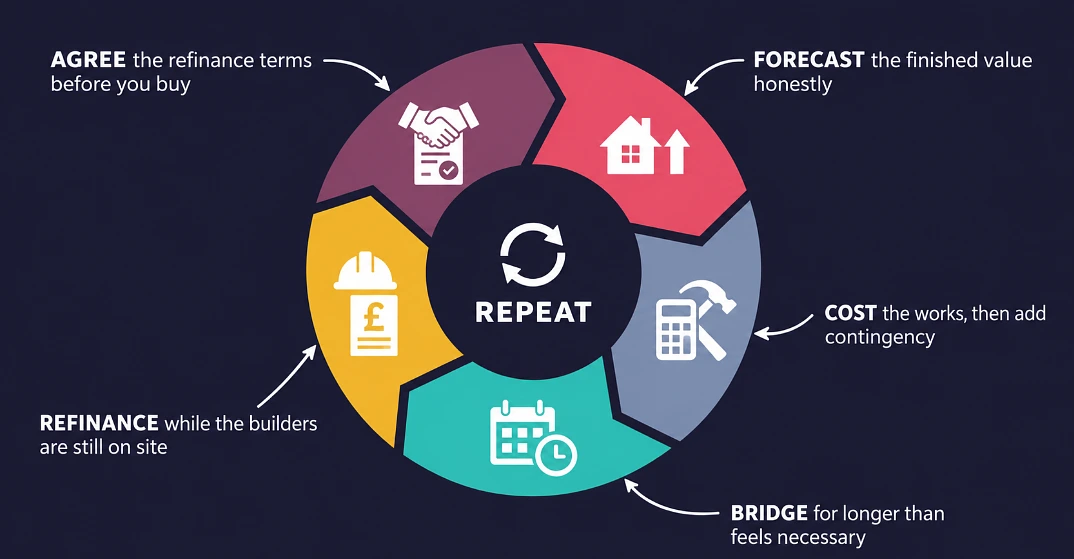
The investors that operate this successfully are not being especially clever. They are just doing things in the right order.
The sequence that works:
- Agree the refinance criteria before the purchase, not after.
- Get an honest valuation forecast for the finished property.
- Cost the works properly, then add a contingency on top.
- Take the short-term facility for longer than feels necessary.
- Start the refinance application while the builders are still on site.
That last one is the one most people skip over. It is also where some of the easiest savings sit. Refinance applications process in weeks. Starting it during the tail end of the works rather than after can shave a month or more of rolled-up interest right off the top of your project cost. On a £200,000 facility at 0.85%, one month saved is roughly £1,900 that stays in the deal rather than going to the lender.
Velocity during the inbound process matters too. Average times to completion have sped up across the market, bridging deals completed in 43 days on average during 2025, the fastest since 2017. Share of market transactions involving heavy refurbishment also increased from 9% to 11% over the same timeframe, so a lot of investors are clearly betting on this strategy.
For anyone running this cycle more than once, the principle is straightforward even if the execution is not: faster in, faster out, and as little rolling up in between as the timeline would allow.
The Sequence That Stops Deals From Stalling
Refurbish. Refinance. Repeat still works. It pays out investors who are able to recognise potential where the high street will not. Rolled up interest is what makes it achievable without a bank of cash behind it.
But only when each phase plans for the next phase in the cycle.
If someone were to begin with the exit and work backwards to the purchase, and if they were to treat every month of rolled-up interest as a fee that had been elected rather than one that just occurred, then deal 3 in that series would be dramatically easier than deal 1 had been.
If you get the sequence wrong, though, you are not running a machine. You would just be paying for one, which is a distinction that tends to become very clear around month 14 when the redemption statement arrives.