

Blog
The Best Villages And Towns In The Lake District

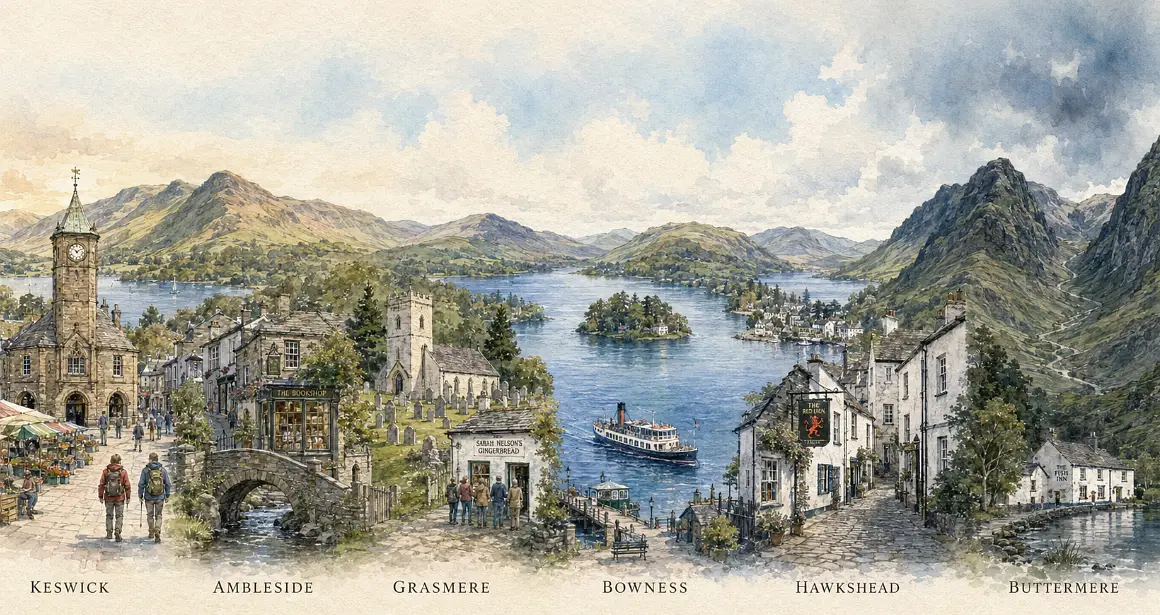
The short answer: Keswick for walking, Bowness for first-timers and families, Grasmere out of season for a literary weekend, and Hawkshead, Cartmel or Buttermere when the obvious bases have been done. Ambleside if no decision can be reached at all.
That is the honest summary. The longer version is where it gets interesting, because the reasons matter as much as the picks.
A quick orientation before the sections begin:
- Keswick. Northern Lakes, market town, the proper walker’s base.
- Ambleside. Central, practical, the sensible middle ground.
- Grasmere. Wordsworth country, gingerbread, beautiful in low season.
- Windermere and Bowness. Lake-focused, family-friendly, busy.
- Hawkshead, Cartmel, Buttermere. The quieter alternatives for repeat visitors.
Opinions are allowed. The list below has them.
Keswick. Still The Walker’s Town, Still The Right Answer For Most People
Keswick gets accused of being busy, twee, full of fleece-clad daytrippers in the wrong shoes, and most of those accusations are fair. None of them stop it from being the most useful base in the Lake District if you actually want to walk.
The geography does the work:
- Derwentwater on one side, with the launches making the lake feel like part of the town.
- Skiddaw rising behind, England’s fourth-highest mountain, walked from the town centre.
- The Borrowdale fells south, opening into the valley everyone falls in love with.
- Cat Bells across the water, the friendliest starter mountain in England.
Wainwright called Cat Bells one of the great favourites, a family fell where grandmothers and infants can climb the heights together. That has been the truth of it for the best part of seventy years.
The town itself runs around a proper market square with Moot Hall sitting in the middle of it, the way market squares do in the North when they have not been redesigned out of usefulness. Saturday morning is the market. Fitz Park is two minutes from the centre. The Lakeland Pedlar is the kind of café that should exist in more places than it does.
The accommodation in Keswick that actually puts you on the square itself means the car stays parked for a long weekend, which in the Lakes in season is its own reward.
The pencil museum sounds like a punchline and turns out to be quietly interesting, on the principle that anything specific and well done is interesting if you give it twenty minutes. The graphite came out of Borrowdale. The first pencil factory in the world was here. Nobody is saying it should be a primary reason to visit, but on a wet afternoon when the cloud has come down and Skiddaw has vanished, worse things have been done with an hour.
The pubs are the test of a Lake District town, and Keswick passes.
- The Dog and Gun. Small, low-ceilinged, serves a goulash that has become its own legend.
- The George Hotel. Goes back to the seventeenth century and looks it.
- The Wainwrights’ Inn. Named for what it is named for.
None of these are claiming to be Michelin destinations. They are claiming to be pubs in a walking town, and they do that job.
Ambleside. The Sensible Compromise
Ambleside is what you choose if you cannot decide. Closer to the central fells than Keswick, easier to reach from the south than anywhere further north, and just busy enough to have proper shops without being so busy that getting into the Apple Pie for breakfast becomes a campaign.
A few specific things that earn it the pick:
- Fred Holdsworth’s bookshop on Central Buildings, on the go since the 1970s and the kind of independent that knows its own stock.
- Bridge House over Stock Beck, apparently built in the seventeenth century to avoid land tax, which is exactly the sort of detail Ambleside likes about itself.
- The Stagecoach 555 running through, so arrival by train at Windermere makes the rest of the central Lakes available without driving.
What Ambleside is not, particularly, is dramatic. It does not have Keswick’s amphitheatre of fells. It does not have Grasmere’s literary pedigree.
What it does is put you within easy striking distance of Wansfell, Loughrigg, the Langdales, and the head of Windermere, and it does that job well enough that plenty of people who know the Lakes properly choose Ambleside year after year. There is no shame in the sensible answer.
Grasmere. Wordsworth, Gingerbread, And A Question Of Tolerance
Grasmere is beautiful and Grasmere knows it. The village sits between the lake of the same name and Rydal Water, surrounded by some of the prettiest small fells in the south, with Dove Cottage on one side and the Wordsworth Museum a few hundred yards from it.
The poet did most of his important work here. The tourism has been steady since the 1830s, when his fame turned the village into a literary pilgrimage site for the Victorian middle class.
What this means in practice: Grasmere in July is somewhere between charming and impossible, depending on the weather and your tolerance for coach parties. Out of season it is one of the loveliest places in the country.
The actual draw, for many regular visitors, is Sarah Nelson’s Grasmere Gingerbread, made at the same shop next to the church since 1854. The recipe is genuinely the same recipe. The shop is tiny. The gingerbread is unusual enough to be worth queueing for, somewhere between a biscuit and a cake, slightly chewy, properly spiced. Worth the stop even if Wordsworth is not your reason for being here.
The walks out of Grasmere are some of the easiest good walks in the Lakes:
- Easedale Tarn, an hour up and an hour back, with the tarn itself a proper destination rather than a stopping point.
- Helm Crag, the rocky summit known as the Lion and the Lamb, visible from the village.
- Loughrigg Terrace, gentle, low, with the best lake views in the area.
All under two hours, all properly scenic, none requiring a serious approach.
Windermere And Bowness. The Honest Verdict
Windermere and Bowness get treated as the obvious first-time-visitor choice and there is a reason for that. Windermere is the only Lake District station on the main line. Bowness is on the lake itself.
The infrastructure for casual visitors is well established:
- The steamers and shorter cruise boats running across the lake.
- The cinema at the Old Laundry, surprisingly good programming.
- The Beatrix Potter attraction, fine if you have children.
- The Hawkshead ferry across the lake to the quieter west side.
For families, for first-time visitors, for anyone who wants the lake itself rather than the fells, this works. The boat trip from Bowness to Ambleside and back is one of the genuinely useful day trips in the area. Belle Isle sits in the middle of the lake doing what it has done since the Romans built the first house on it.
What Bowness is not is quiet. In high summer it is the most concentrated tourist crowd in the national park. The fells from here are further than from Keswick or Ambleside. The serious walking is more of a drive.
The romance of the place depends entirely on staying somewhere with a proper view of the water and getting out early before the day crowds arrive. Picked for the right reason, fine. Picked for the wrong reason, less fine.
The Quiet Picks. Hawkshead, Cartmel, Buttermere
Beyond the obvious bases, the Lake District rewards going smaller. Three villages worth knowing about specifically.
Hawkshead is the prettiest of the small villages. A white-walled cluster of cobbled lanes between Coniston Water and Esthwaite, with no through traffic in the centre and the Beatrix Potter Gallery in what used to be her husband’s solicitor’s office. The Kings Arms does the kind of food a village pub should do. The Drunken Duck a mile out at Barngates does the kind of food it should not have to, given how small it is. Either earns a stop.
Cartmel sits south of the main park boundary and gets visited for two specific things:
- L’Enclume, Simon Rogan’s restaurant, holding three Michelin stars and pulling people from London for the weekend.
- The racecourse, which runs jump meetings on May and August bank holidays, with the kind of village-fair atmosphere that flat racing lost a generation ago.
Sticky toffee pudding was reputedly invented at the Cartmel Village Shop, which still sells it and still has a queue most days.
Buttermere is the quiet one. A small village between two lakes, Buttermere and Crummock Water, surrounded by the steep western fells. Miles from the nearest railway and reachable only by single-track road over the Honister or Newlands passes. The Fish Hotel is a proper old coaching inn.
The walk around Buttermere itself is one of the great lakeshore circuits in England. Four miles, mostly flat, undersold by every guidebook that mentions it.
These three are not first-visit destinations. They are second, third, and fifth visit destinations. The Lakes start revealing the version of themselves that the day-tourism never quite reaches.
Which Base To Pick
The honest answer depends on what the trip is for.
- For walkers and the proper Lake District experience: Keswick. Every time, regardless of the crowds. The fells are too good and the town is too useful to bother with anywhere else.
- For first-time visitors, families, or anyone who wants the lake itself: Bowness or Windermere. The caveat is that staying somewhere with a view matters more than the town itself.
- For a literary or romantic weekend out of season: Grasmere. In peak season, Ambleside instead, with a day trip into Grasmere when the morning is quiet.
- For people who have done the Lakes before and want to see the rest of it: Hawkshead in summer, Cartmel for a long weekend, Buttermere for a remote week with proper walks.
The Lakes are small enough that minds can be changed mid-trip. They are also varied enough that the choice matters. Get it roughly right and the rest takes care of itself.