

Blog
Notting Hill Carnival Turns 60: Drummers, Dancers and Sound Systems Fill West London

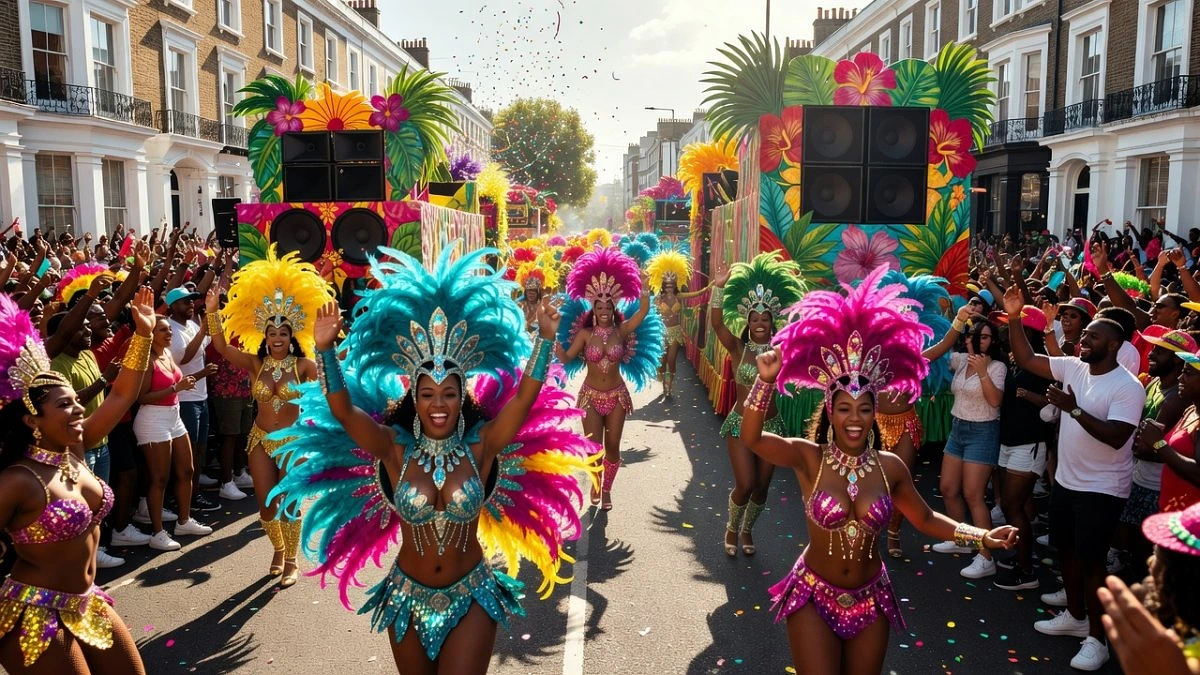
The first whistles went up on Great Western Road well before the parade reached it, which is usually how the last Monday of August starts around Ladbroke Grove. By half ten the Adults’ Parade was moving, and the mas bands that have spent the best part of a year sewing, wiring and bending feathers into shape finally got their four hours on the road.
Sixty years since Rhaune Laslett organised a children’s street party in a neighbourhood dealing with racial tension and poor housing, Carnival is billing 2026 as its Diamond Jubilee.
What Took Place Over the Three Days
Panorama on Saturday, J’Ouvert at Dawn on Sunday, Main Parade on Monday
Saturday belonged to steelpan. The UK National Panorama competition, held at Emslie Horniman’s Pleasance Park, is the only ticketed part of the weekend, and Junior Panorama put the next generation of players on the same stage.
Sunday started in the dark. J’Ouvert ran from 6am to 9am, the traditional opening with steel bands and African drummers moving through the streets and paint and powder going everywhere. The official opening ceremony followed on Great Western Road from 10am, then the Children’s Day Parade, then Dutty Mas.
Monday brought the main event. The Adults’ Parade began at 10.30am, with sound systems and live stages running from noon to 7pm and the parade itself continuing until around 8.30pm.
This Year’s Costumes Followed an Indian Ocean Theme
The bands built to the theme in blues, oranges and pinks. Feathered headpieces, wire frames, sequins and beadwork, all of it made across months of work.
Costumes are kept secret until close to the day, even from the people wearing them. BBC Radio 1Xtra presenter Nadia Jae, who joined one of the masquerade bands rather than covering it from a stage, told BBC Newsbeat her costume was an explosion of colour and that she had not seen it until the week of Carnival.
She described playing mas as beautiful, cultural and collaborative, and compared the year of preparation the band organisers put in to training for a marathon.
Anyone without a band costume turns up in their own. Whistles and horns are effectively the uniform for spectators, and nobody stands still on the pavement for long.
Soca Behind the Trucks, Reggae and Bashment at the Sound Systems
Two different things happen at once, and they are worth separating.
On the road, the masqueraders wine and chip behind the trucks, moving to the soca the DJ on the flatbed is running. That is the parade proper, judged on costume and choreography as bands pass the Judging Zone on Great Western Road.
At the sound systems, it is a different crowd and a different dance entirely. Reggae and dub skanking at Channel One and Aba Shanti-I. Bashment at King Tubby’s and Nasty Love. House at KCC. Ska at Gaz’s Rockin’ Blues, hip-hop at Rapattack, hard house and techno at Pineappletribe. Rampage and Disya Jeneration run multi-genre.
More than 30 static sound systems hold the same West London corners they have occupied for decades, playing from midday to 7pm on both days.
A New MAGNUM Stage Was Added at Powis Square for the Anniversary
Three main stages carried live performance: Emslie Horniman’s Pleasance Park, Powis Square and Meanwhile Gardens.
The new MAGNUM Stage at Powis Square was introduced for the 60th, with the programme produced by the artist Alvaro Barrington.
Carnival Stopped for 72 Seconds at 3pm for the Grenfell Victims
It happened on both Sunday and Monday, one second for each of the 72 people who died in the Grenfell Tower fire, and for the Carnival members and pioneers who have died.
Grenfell stands a short walk from the parade route. The silence has been part of Carnival since 2017 and it holds, even in a crowd of that size.
Carnival Pioneers Marked the Anniversary Alongside a Crowd of Up to Two Million
Attendance across the weekend is put at somewhere between one and two million.
Alongside the crowd, the people who built the thing. Linett Kamala, one of Carnival’s first female DJs and now a Carnival director. Alexander D Great, three-time UK Calypso Monarch. Michael “Soca Massive” Olton, who brought soca onto the road in 1984 and leads the only traditional Sailor Mas band still parading. Rosita Lynch, goddaughter of the late Russell Henderson MBE, whose steel band led the very first procession.
All four have taken part in Carnival 60, a six month programme of walks, talks, suppers and exhibitions based at Westbourne Park, and all four have used it to raise the same question about money.
The Mayor Added £4.66m for Safety After Two Uncertain Years
Matthew Phillip, chief executive of Notting Hill Carnival Ltd, described 2026 as six decades of costumes, colour, sound, steelpan, calypso, soca and sound systems, and six decades of a community that turned exclusion into expression and struggle into celebration. He was clear that Carnival did not begin as a spectacle but as something the community needed.
The March 2026 commitment came on top of £946,300 already pledged by City Hall, and followed two years in which the event’s future looked genuinely uncertain.
Against that, Carnival generates close to £400 million a year for London, a gap the Carnival 60 panel has pushed on repeatedly.
Notting Hill Gate Closed to Traffic, and Two Afterparties Run Tonight
A section of Notting Hill Gate was shut to everything except buses across both days, a first this year.
Ladbroke Grove and Notting Hill Gate stations run exit-only or queue-controlled through the afternoon, with Paddington, Shepherd’s Bush and Queens Park the standard alternatives.
For those carrying on, Scala in King’s Cross hosts a soca afterparty from Release D Riddim, and The Steel Yard on Cannon Street closes the weekend with kaskawi band La Rouge.