

Blog
National Fitness Day Is on 16 September, and the Strength Gap Is the Number Worth Paying Attention To


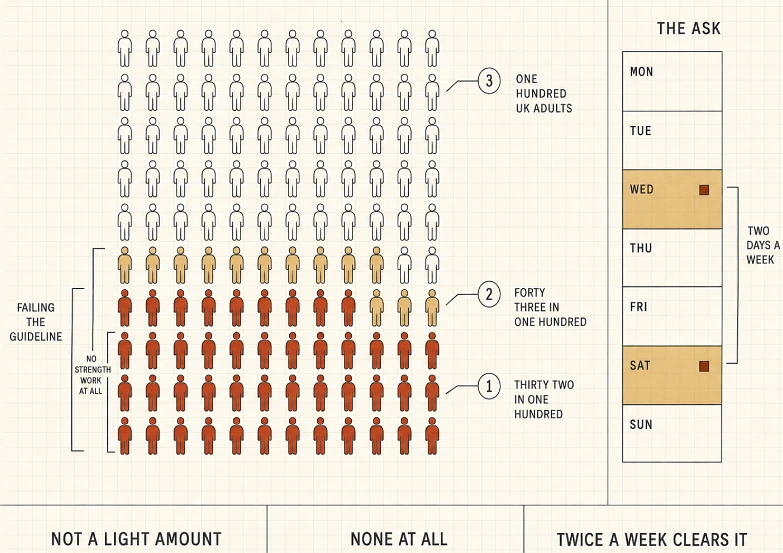
Nearly half the country is skipping the one bit of exercise the Chief Medical Officer asks for twice a week. 43% of UK adults are failing to meet the strength guidelines, and 32% do nothing at all to strengthen their muscles, according to research from ukactive and Les Mills.
That is a third of the adult population doing zero resistance work of any kind. Not a light amount. None.
Which makes this year’s National Fitness Day a more useful hook than usual, because the campaign has spent most of its life being associated with mass walks and dance offs, and the actual hole in the nation’s activity levels is sitting somewhere else entirely.
The Day Falls on Wednesday 16 September and Most Sessions Are Free
Now in its fifteenth year, National Fitness Day is coordinated by ukactive and delivered through its member facilities, which means gyms, pools, leisure centres and studios across England, Wales, Scotland and Northern Ireland adding on free activities for the day. Roughly 10 million people take part in an average year.
Cameron Saunders, ukactive’s chief executive, framed it as showing the nation that physical activity is for everyone regardless of age, background or experience.
ukactive is also releasing a toolkit for anyone running something on the day, with social assets, posters, banners and guidance on hosting. Useful if you run a studio or a workplace and want to add something on without building it from scratch.
A Record 12.2 Million People Now Belong to a UK Gym
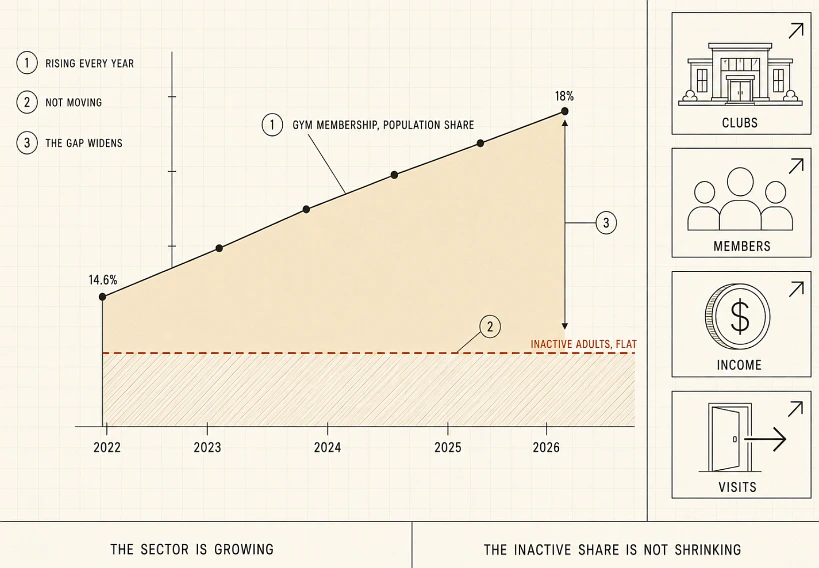
The backdrop to all this is a sector that has just posted its best set of numbers on record.
| 2026 figure | |
|---|---|
| Members aged over 16 | 12.2 million |
| Penetration of the over 16 population | 18%, an all time high |
| Total sector income | £6.5 billion, up from £5.7 billion |
| Annual visits | 679 million, up 10% |
| Clubs | 5,842, up 4.2% in a year |
Those come from the UK Health & Fitness Market Report 2026, published in April by ukactive with Sport England and 4GLOBAL. Penetration has climbed roughly a percentage point a year since the data series started, from 14.6% in 2022.
And yet a quarter of adults in England are still classed as inactive, averaging under thirty minutes of physical activity in a week. Women, people from lower socio economic groups, and Black and Asian communities are all less likely to be active than the average. Record membership numbers and a stubbornly inactive quarter of the country are sitting side by side, which is most of the reason the campaign exists.
The Workplace Version Runs for 20 Days, Not One
Total Active Hub has been picked by ukactive to run the workplace programme this year, and their 20/20 challenge asks people to move for twenty minutes a day for twenty days.
It starts on 16 September and runs through to 5 October. Free to register, no venue needed, which makes it about the only version of this that works for a distributed team.
Machines Are Where Most Beginners Actually Start Strength Training
If the strength gap is the problem, the honest question is what a completely untrained person does about it on the Thursday after National Fitness Day, and the answer is almost never a barbell.
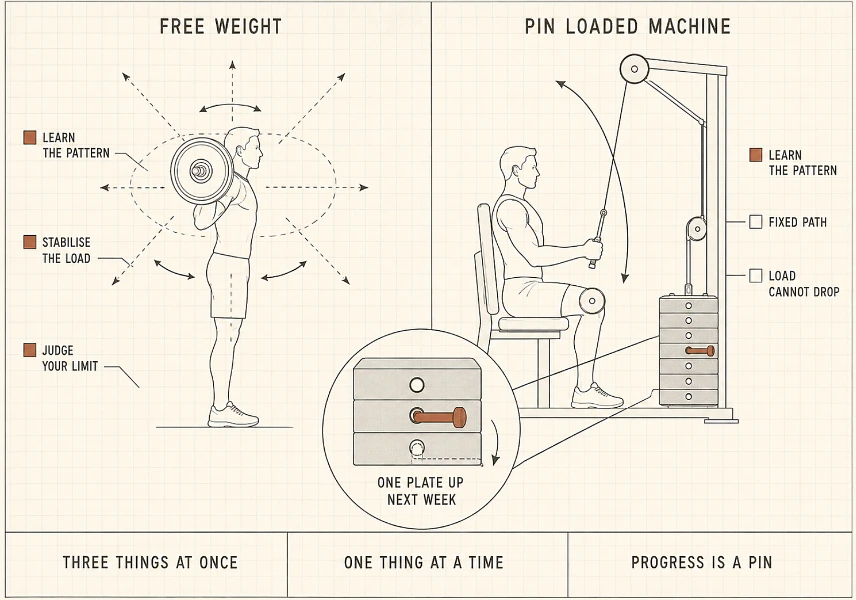
Factory Weights ask you to learn a movement pattern, stabilise the load and judge your own limits, all at once, in front of people. That is a lot to take on in week one. A weight stack and a pin remove two of those three problems, because the path of the movement is fixed and the load cannot land on you.
This is where pin loaded gym machines do the work that nothing else really does, whether that is a lat pulldown, a chest press or a leg press. You sit down, you set the pin, you find out what you can move, and you go up a plate the following week. Changing the weight takes two seconds, so drop sets and pyramids are practical rather than a faff, and the whole thing is self contained enough that a gym can add one station at a time as it grows.
The CMO guidance is muscle strengthening activity on at least two days a week. Two machine sessions covers it.
What to Do on the Day if You Have Not Set Foot in a Gym
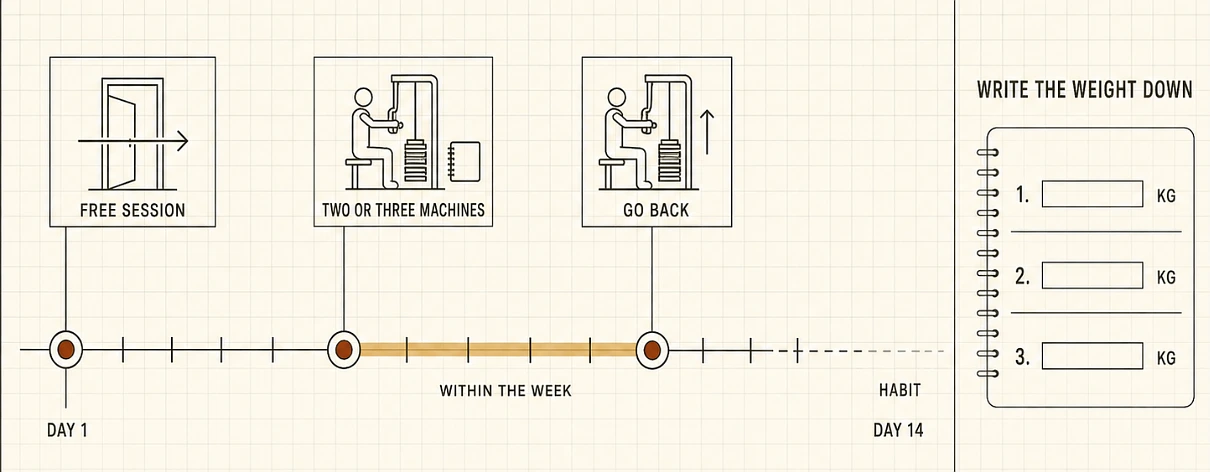
Keep it small. The people who last are almost never the ones who went hardest on day one.
- Check what your nearest leisure centre is adding on, since most sessions on 16 September are free and you can try a place without joining it.
- If you go into a gym, ask for an induction. It is usually included and most people never book it.
- Do two or three machines rather than the whole circuit, and write down what weight you used.
- Go back within the week, because the second session is the one that decides whether this becomes a habit.
Worth Saying Plainly
One day in September will not move a national statistic. What might move it is the fact that a third of adults doing no strength work at all is finally being talked about as the specific gap rather than folded into general inactivity, because “do some strength training twice a week” is a far more actionable instruction than “be more active”.
The free sessions are the easy part. Whether anyone comes back on the 23rd is the bit that matters.