

Blog
The Rise of Niche Dating Apps: Why the Swipe-Everything Era Is Dying — and What’s Replacing It

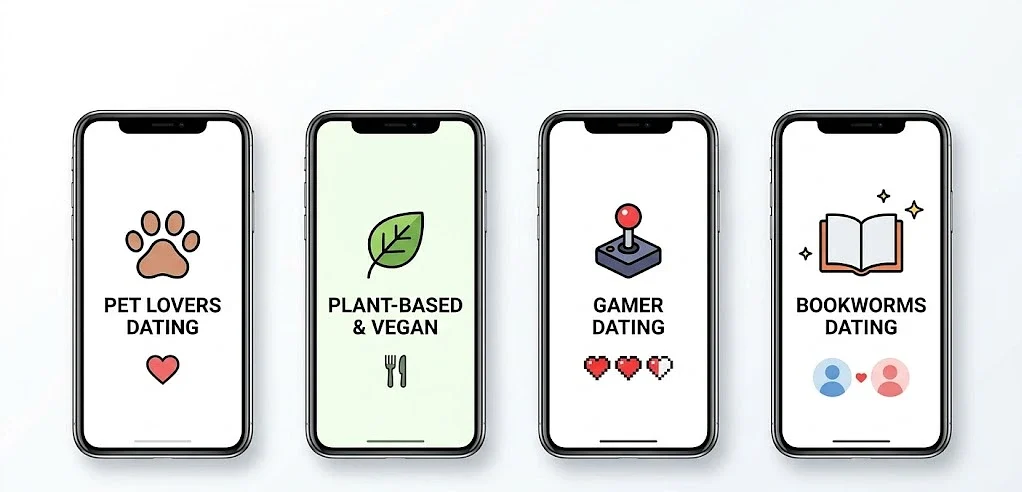
You open the app. You swipe right forty times. You get three matches. One never replies. One sends “hey” and disappears. The third seems promising until the conversation dies somewhere around Thursday. You close the app, tell yourself you’ll try again next week, and wonder why this feels the same as it did six months ago.
If that cycle sounds familiar, you’re not imagining the problem.
Match Group, the company behind Tinder, reported that Tinder’s paying subscribers dropped 8% year-on-year in Q4 2025. That’s not a wobble — Tinder’s full-year revenue fell 4% to $1.9 billion, and the decline has now stretched across roughly twelve consecutive quarters. Bumble’s numbers are worse. Paying users fell 16% by Q3 2025, landing at 3.6 million. Revenue dropped 10%. These aren’t small apps struggling for attention. These are the two biggest names in online dating, and both are bleeding users.
Ofcom, the communications regulator, tracked what’s happening closer to home. Tinder lost 600,000 users since 2023. Bumble dropped 368,000. Hinge shed 131,000. Even Grindr, which operates in a more defined community, lost 11,000. Nearly 5 million adults still visited a dating service in May 2024, but the direction is clear — and it’s downward.
A Forbes Health survey of 1,000 dating app users found 78% reported feeling emotionally exhausted by the experience. Younger generations felt it hardest — 79% of Gen Z users reported burnout, with millennials close behind. The top reason wasn’t bad dates or creepy messages. It was simpler than that — 40% said their biggest frustration was the inability to find a genuine connection. They were swiping, matching, chatting, meeting — and still ending up exactly where they started.
What actually went wrong with mainstream dating apps?
The honest answer is that the apps were never designed to find you a partner. They were designed to keep you using the app.
That sounds cynical, but the business model makes it obvious. The entire revenue engine depends on a constant churn of new sign-ups replacing the people who gave up or got frustrated. If everybody found a relationship in month two, the company would collapse. The incentive structure points away from success, and users eventually figured that out.
Pew Research data from 2023 reflects this. Among Americans who’ve used a dating app, 46% describe their overall experience as negative — a substantial chunk, even if a slim majority (53%) still land on the positive side. The core problem isn’t the technology — it’s the absence of context. When you swipe with a person in a mainstream app, you are aware of their appearance and possibly of their love of travelling. You have no idea whether they share your values, how they resolve conflict, what type of relationship they seek, or whether their vision of a Sunday morning has any similarity to your own. Each and every discussion begins at the point of zero, and hundreds of times are taxing cumulatively.
The large platforms evidently discern the trouble. Tinder’s parent company invested $60 million in an AI-based product redesign. After its launch in March 2025, Hinge had a recommendation engine that increased matches and contact exchanges by 15%. Bumble is working on a brand new AI-first company that will be launched by the middle of 2026. The question of whether all this would reverse years of cumulative user fatigue is truly open-ended. However, as the giants are scurrying to redefine themselves, another model has been creeping up.
Why smaller, more specific platforms are winning
One old saying has it, birds of a feather flock together, and, as it happens, there is quite a considerable body of research to support the statement. A highly read article by Psychological Science in the Public Interest (Finkel, Eastwick, Karney, Reis and Sprecher, 2012) revealed that matching algorithms based on personality have severe shortcomings in their predictive capacity of long-term relationship success, and that shared experience, similar social networks, and shared lifestyle patterns are what actually correlate with compatibility. That is, it is not a personality test that makes two individuals click, it is already something meaningful in common before the initial message.
This is precisely what niche dating sites provide by virtue of their design. These platforms create communities based on identity instead of dumping all individuals in the same large pond and hoping that an algorithm cleans up the mess. The dialogues begin further down the line. The misconceptions are fewer. The anticipations are pre- aligned.
And user reaction is on. One of the oldest niche platforms, Grindr, has increased revenue by 25% in Q1 2025, boasting 14.6 million monthly active users and higher subscriber loyalty than the vast majority of mainstream competitors. According to their own statistics, Ofcom found that Grindr users spend over seven hours in-app on average, over an hour on Tinder. That’s not addiction. It is a community that people would desire to live in.
The landscape now spans practically every identity, lifestyle, and relationship preference you can think of:
- Feeld — built for polyamorous, sexually open, and ethically non-monogamous communities
- Muzz — connects Muslim singles with shared faith and cultural values
- JDate — has served Jewish communities for over two decades
- HER — designed for LGBTQ+ women and non-binary people
- Ourtime — targets the over-50s, where mainstream apps have historically done a poor job
- Kippo — built specifically for gamers, with profile elements that reflect gaming identity
- Pure — caters to people looking for casual encounters without pretence
- Sugar Daddy Planet — operates in the sugar dating space, where the relationship model is understood from the outset, removing the awkward dance of unspoken expectations that plagues mainstream apps
- BLK — the largest dating app for Black communities, where over 30% of users in 2024 reported using the platform to make friends in addition to dating
That final point of BLK is one to ponder on. When a significant proportion of the people on a dating application visit it in part to make friends and community, rather than love, that reveals something about what individuals are indeed seeking. They’re not just looking for a date. They want their own place where they feel they are heard before anyone has even greeted them.
Does shared interest actually equal compatibility, though?
Not automatically, and being honest about that matters.
You and someone else might both be passionate vegans, or devoted football supporters, or committed to the same relationship structure — and that tells you absolutely nothing about whether you communicate well, handle disagreements gracefully, or actually enjoy each other’s company over a meal. Shared identity is a strong starting point. It creates common ground that mainstream apps simply can’t replicate. But common ground isn’t a substitute for the harder, slower work of actually getting to know someone.
Pool size is the other practical limitation. The more specific the niche, the thinner the numbers get. Apps that operate micro-communities — some with fifty or more sub-niches — have drawn mixed feedback precisely because many of those communities are functionally empty outside major cities. If you’re in London or Manchester, you’ve got options. If you’re in a market town in Lincolnshire, your carefully curated niche app might have twelve active users within a fifty-mile radius. That’s a genuine constraint, and glossing over it would be dishonest.
The people who’ve stopped using apps entirely
There’s a broader cultural shift happening that goes beyond niche versus mainstream. Some people have decided the entire app-based model — regardless of how specific it is — doesn’t work for them.
Ofcom flagged this directly. The slight overall decline in dating service usage across Britain is partly driven by Gen Z gravitating towards what Ofcom called “meet cute” dating — spontaneous, in-person encounters that feel less engineered. Speed-dating events, activity-based social clubs, curated introduction services, friend-of-a-friend setups. These aren’t new ideas, but they’re experiencing a revival because a generation raised on dating apps has decided the format itself might be the problem.
A Bloomberg report from February 2026 highlighted research arguing that human beings are wired to build compatibility through shared experience over time, while dating apps of every kind reward snap judgements and preset preferences. The growing “anti-app” movement isn’t just a rejection of Tinder. It’s a challenge to the idea that romantic connection can be reliably initiated through a screen at all.
Whether you agree with that or not — and plenty of people who met their partners through apps would push back hard — the existence of the movement tells us something. The dating industry spent a decade insisting that more options meant better outcomes. A growing number of people have looked at the evidence and concluded the opposite.
So where does that actually leave you?
It leaves you with more choices than you’ve ever had, which is both the good news and the complicated part.
If mainstream apps feel like a treadmill — same swipes, same conversations, same outcomes — that frustration isn’t personal. It’s structural. The platforms were built for engagement, not resolution, and the numbers confirm that the majority of users share that feeling.
Niche platforms genuinely address part of the problem. They work not because they’ve cracked some algorithmic code the big apps haven’t, but because they assemble communities where shared context already exists. The reason platforms like Feeld, Kippo, or Sugar Daddy Planet work for their users is that everybody in the room has already agreed on the basics before a single message gets sent. That removes an enormous amount of friction.
But no app — niche or mainstream — removes the need to actually show up as a person. To be curious about someone. To tolerate the awkwardness of early conversations. To accept that compatibility unfolds over weeks and months, not in the first three messages.
The era of casting the widest possible net and hoping for the best is giving way to something more intentional. Whether that means a niche platform, a curated event, a social club, or simply being clearer about what you actually want before you start looking — the shift is real, and the data says it’s working better than the old model.
As the saying goes, you can’t catch the right fish with the wrong bait. The dating industry is finally learning what its users figured out years ago: specificity beats volume, every single time.