

Blog
Why Two Identical Salons End Up With One Fully Booked And One Half Empty

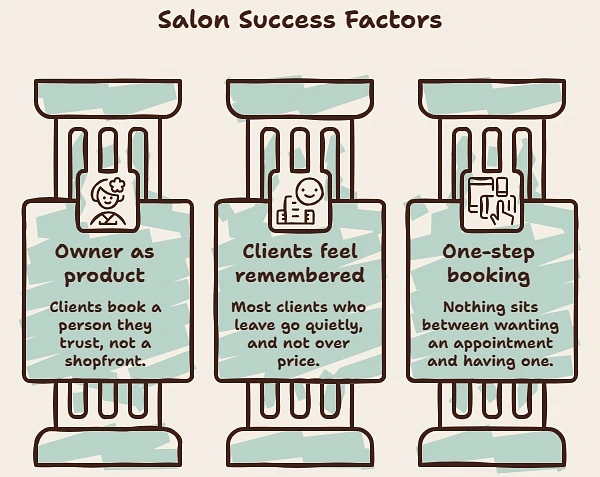
Two salons, same postcode roughly, same prices, same standard of work, one of them turning people away most weeks and the other one wondering why Instagram isn’t doing what everyone promised it would. That gap has almost nothing to do with talent, it is almost never about talent, and it comes down to three specific things that are actually provable, not just three tips somebody made up for a blog.
I asked Francesca Smeriglio about this straight out, she works in marketing at Booksy Biz for business and has written enough of their client-facing content herself to know which levers actually move a chair from empty to booked, and when I ran the strongest of the three past her she didn’t hesitate, this is the one with the most real precedent behind it, not a theory.
Your Own Name Is Worth More Than Your Salon’s Name
Josh Wood started with a Saturday job in a salon in Barnsley and trained at Vidal Sassoon in Leeds, and by 2011 he’d opened his own place, Josh Wood Atelier, in Holland Park, then a year after that a second one inside Liberty, which made him the first hair salon ever to operate inside that department store. Marks & Spencer put a thirteen-product Josh Wood range on their own shelves in 2014. By 2018 Josh Wood Colour existed as its own company and had raised 6.5 million dollars in its first funding round, and he’s Redken’s Global Colour Creative Director now, still turns up on This Morning as a guest host every so often.
None of that happened because Barnsley needed another decent colourist. It happened because at some point Josh Wood stopped being an employee of a salon and turned into the actual product people were booking.
And Nicky Clarke did more or less the exact same thing a generation earlier, except he went even further with it. Trained under John Frieda, built his own Mayfair salon out of a twenty thousand pound loan, and by the time Buckingham Palace handed him an OBE in 2008 he already had a haircare range behind him that had done something no British haircare brand had managed before it, become the first luxury line to land on a national supermarket shelf. Tesco stocked his own range exclusively from 2015. He styled Princess Diana. He styled the late Queen. Neither of them walked in because the salon’s signage was clever.
Both cases run on the same pattern really, the owner became the brand instead of hiding behind one, and once that happens the marketing more or less writes itself, because people stop booking a haircut and start booking access to a specific person they already trust.
Most independent salons are doing the opposite of it. The owner stays invisible, the Instagram account posts the work and never the person behind the work, and clients end up loyal to a brand with no face on it, which is a noticeably weaker kind of loyalty than the one Josh Wood or Nicky Clarke actually built for themselves.
The Real Reason Clients Stop Coming Back Has Nothing To Do With Price
A client stops booking, and almost every salon owner jumps straight to the same conclusion, they must have found somewhere cheaper. Nobody really checks whether that’s actually true before acting on it.
Is it actually about price though? Industry survey work on client churn says no, not really, 68% of clients who leave do so because they felt indifference, not cost, not a bad haircut even, just the sense that nobody particularly noticed whether they came back or didn’t.
The referral numbers make the same point from a different angle:
| Client source | First-year retention | Two-year lifetime value |
| Referral | 74% | $1,860 |
| Paid ads | 41% | not tracked |
| not tracked | $580 |
Referral clients worth more than triple what the Instagram-acquired ones brought in, at one salon that actually sat down and tracked the numbers properly over two years, and that lines up with what Bain and Company have found across whole industries for years now, that a five percent lift in retention alone can move profit somewhere between 25 and 95 percent, because keeping someone who already trusts you costs next to nothing next to the price of finding someone new.
So the fix most salons actually need isn’t a bigger acquisition budget at all. It’s treating the person who already sat in the chair once like somebody worth remembering, which sounds obvious the moment it’s written down and is somehow the exact thing almost nobody structures properly.
The Booking Moment Is Where Most Of This Effort Quietly Dies
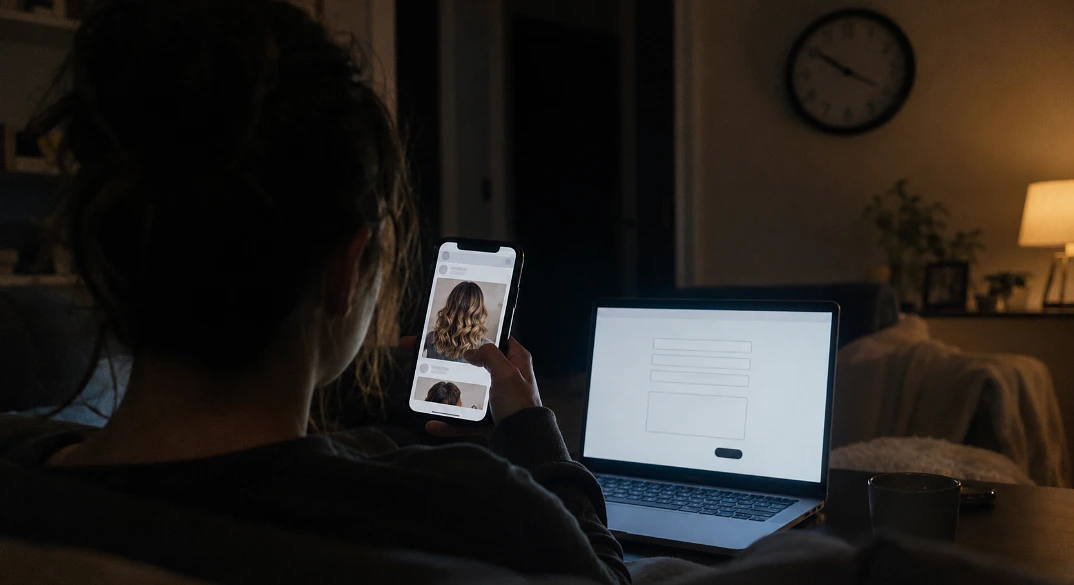
A client sees the Instagram post and feels the pull, decides they actually want to book, and then hits friction, a phone number nobody answers, a DM that gets seen four hours later, a website showing no live availability anywhere.
That gap between wanting to book and actually getting it done is where a huge slice of marketing effort just evaporates. The interest was genuine. The intention was genuine. It just never converted because there were too many steps sitting between “I want this” and it actually landing in a diary.
Put the three together and they stop being separate tips entirely. Become a name worth booking. Give the people who already trust you a reason to feel remembered instead of forgotten. And once someone genuinely wants to book, make sure nothing sits between that feeling and a confirmed appointment. Most salons manage maybe one of these properly. The ones fully booked most weeks are usually doing all three without necessarily being able to explain why it’s working for them.